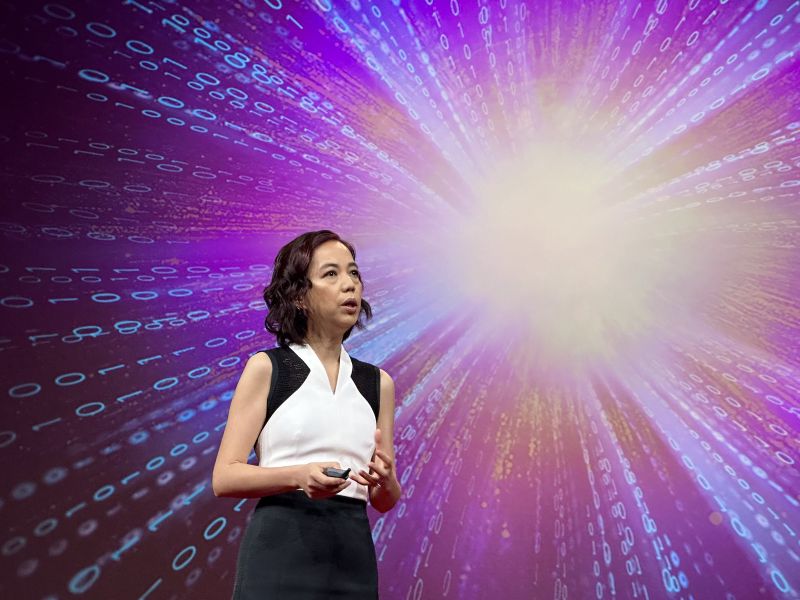
Fei-Fei Li labelled millions of images before anyone asked for them because she thought the field had the problem backwards. Most artificial intelligence researchers of the mid-2000s were refining algorithms and feeding them small amounts of data. “Pre-ImageNet, people did not believe in data,” Li said in an interview at the Computer History Museum. ImageNet was her bet that a big enough collection of labelled pictures would change what machines could learn.
more
The bet took years to pay. When it did, it helped start the deep learning boom that now powers ChatGPT.
What ImageNet was
ImageNet began in 2006, with Li at its head. Her team at Princeton set out to build an image dataset far larger than any before it. It grew to 14 million images, each tagged with one of nearly 22,000 categories.
The aim was at least 1,000 examples for every category on a sprawling list, from throw pillows to violins. Thousands of people did the labelling, with help from Amazon’s Mechanical Turk.
The work changed how Li looked at the world, she told WIRED. Walking past a dog or a chair, she began asking which visual clues would let software tell a beagle from a greyhound, or an Eames chair from a Mission rocker. Her team even tried to gather pictures of every possible car model.
Why colleagues thought it was a mistake
Li met doubt from friends and colleagues, as she recounts in her memoir, The Worlds I See. A few months in, in 2007, a mentor told her she had taken the idea “way too far”. The advice was to grow with the field, not to leap ahead of it.
Scale was only part of the objection. Many researchers doubted that the machine learning methods of the day would gain anything from so many images. At the time, neural networks had largely fallen out of fashion, and many had moved on to techniques such as support vector machines.
Li pressed on for more than two years. The project strained her research budget and her graduate students’ patience. When she moved to Stanford in 2009, she took several of those students, and ImageNet, with her.
Where the nerve came from
WIRED traced Li’s appetite for the risk to her family. She arrived in the United States at 16 with no English. Her parents, despite money troubles, pushed her to turn down a well-paid business job to become a scientist. Pulling off ImageNet, WIRED wrote, would vindicate their sacrifice.
How the payoff arrived
ImageNet was finished in 2009, and at first few people noticed. Li started a contest in which researchers trained their algorithms on the dataset to see how well computers could identify objects.
In 2012 the winner was AlexNet, from Geoffrey Hinton’s lab at the University of Toronto, and it made a huge leap over earlier entries. The model took its name from its lead author, Alex Krizhevsky. Ars Technica argues that AlexNet would not have worked without ImageNet. It also needed Nvidia’s CUDA platform, launched in 2006, which let graphics chips run other kinds of computation.
Ars Technica names three people behind the boom that followed: Hinton, Nvidia chief executive Jensen Huang, and Li. Each pursued an idea most of their peers doubted.
What the dataset got wrong
A dataset built from the internet carries the internet’s gaps. Li wrote of a “twinge of culpability” when Google’s software labelled Black people as gorillas. Her book says a web that shows a mostly white, Western and male picture of daily life yields technology that struggles to make sense of everyone.
She went on to launch AI4All, a programme to bring more women and people of colour into the field. She told WIRED that her team knew far less while building ImageNet than the field knows now. Asked if bias in AI can be solved, she said “confident” would be too simple a word.