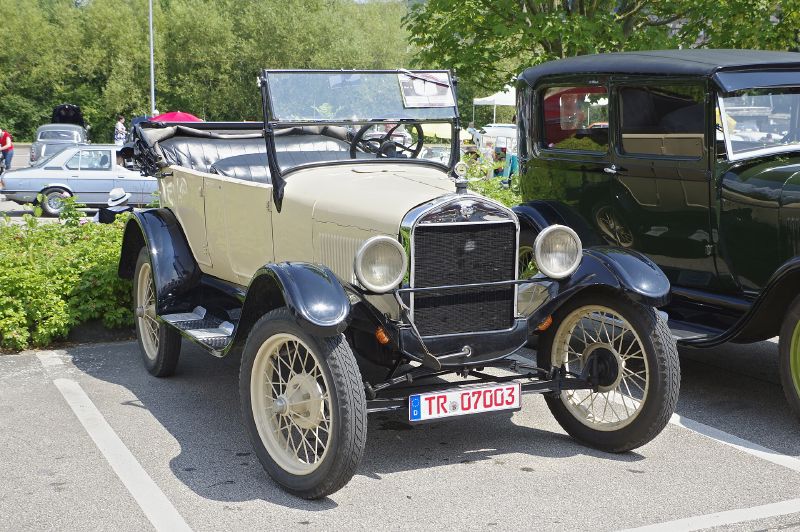
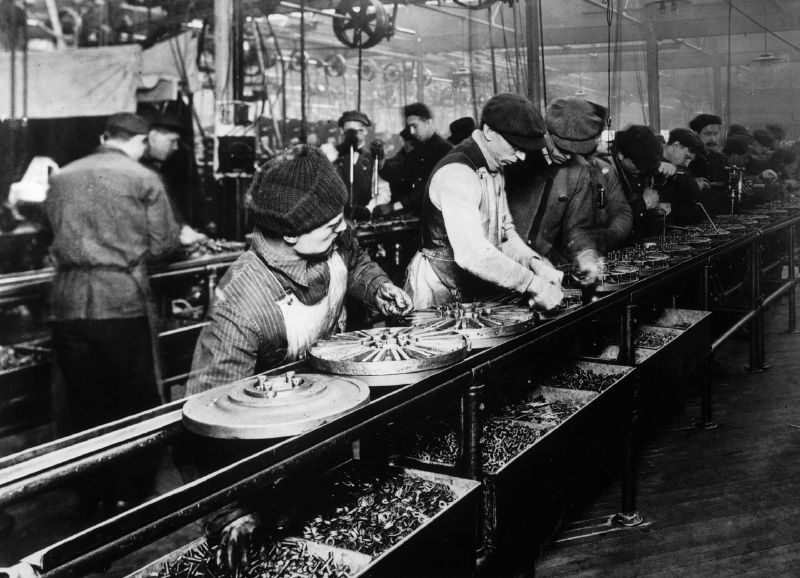
The moving line Ford installed at Highland Park, Michigan, in 1913 turned the car from a hand-built object into a timed flow of parts. According to the American Society of Mechanical Engineers, a Model T that had taken 14 hours to assemble now took 1 hour and 33 minutes.
more
The trick was to move the car rather than the worker. Each worker stayed at one station and repeated a single task on every vehicle that passed. The line worked only if parts, subassemblies and larger assemblies arrived at the moving main line at exactly the right moment.
How fast it scaled
By 1914 Highland Park was turning out 1,000 cars a day, Vaclav Smil wrote in his IEEE Spectrum column, Numbers Don’t Lie. He calls the line the first major step in the Model T’s rise to dominate the market.
Ford’s share of the American car market shows the effect. In 1908 Ford made 15 percent of the cars built in the US. The figure reached 48 percent by 1914, and 57 percent by 1923. When the Model T run ended in May 1927, Ford had sold 15 million of them.
What it did to the price
Cheaper building meant a cheaper car, though the two sources give different figures. ASME says the price dropped from $1,000 to $360. Smil tracks the Runabout, the most popular version, from $825 in 1909 to $260 by 1925. He puts that at about two and a half months’ wages for an average worker.
Before the Model T, Ford had sold to the wealthy like its rivals. Its Model K of 1906 cost about $2,800.
What it did to the workers
The repetitive work came with a raise. In 1914 Ford paid $5 a day, which ASME puts at close to double what other carmakers offered. The working day fell to eight hours. That let the company run three shifts round the clock.
Smil counts the wage as the second step in the car’s dominance, after the line itself. IEEE Spectrum had to correct its own article on this point: the $5 was per day, not per hour.
What came after
Ford took the method abroad. Foreign assembly began in Canada and spread to Britain, Germany, France and beyond, as far as Mexico, Brazil and Japan. ASME credits the cheap car with the growth of suburbs, as mobile families let cities spread outward along new highways.
The record for a single model went elsewhere. Volkswagen’s Beetle outsold the Model T, and the last one, built in Puebla, Mexico, was number 21,529,464. Smil still calls the Beetle, in many ways, an updated copy of Ford’s car.