Frances Oldham Kelsey, a medical officer at the US Food and Drug Administration, spent more than a year refusing to approve a German sedative called thalidomide. Her refusal changed how the agency tests and approves drugs.
more
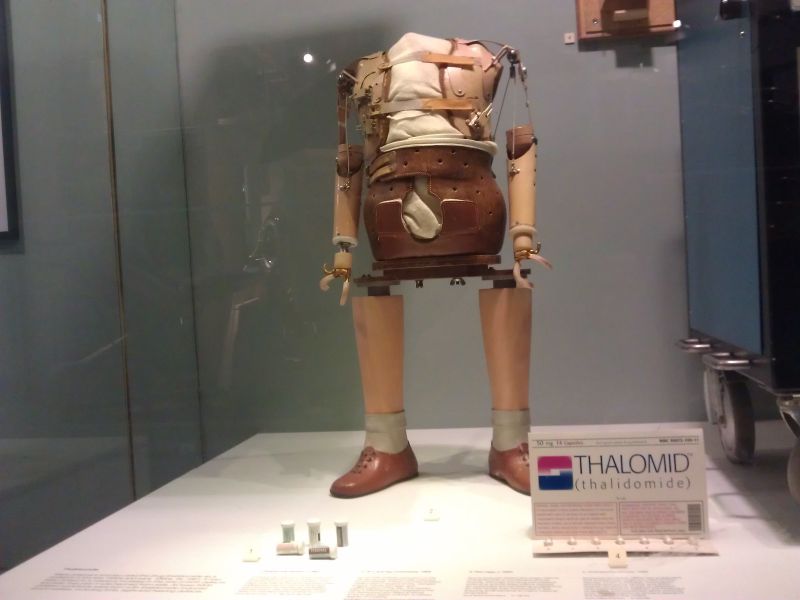
Chemie Grünenthal had patented thalidomide in Germany in 1954 and launched it as a sedative in 1957, marketed as gentle enough to give a pregnant woman for morning sickness. By 1958 it was licensed in the UK and much of the world, but not in the United States. The Cincinnati firm William S. Merrell applied to the FDA in late 1960, hoping to have the drug, branded Kevadon, on US shelves in time for Christmas.
Kelsey was not convinced. Some of the company’s sedation experiments hadn’t kept every test rat asleep, and nobody had tried the drug on a pregnant animal at all. Doctors in the 1950s did not think a drug could cross the placenta, so nobody else saw a reason to check. She kept asking Merrell for more data. Merrell kept pushing back.
While the application sat on her desk, doctors abroad were watching a pattern nobody could yet explain. Between 1957 and 1961, more than 10,000 children across 46 countries were born with congenital deformities, most often phocomelia, the absence of limbs. In the UK alone, 2,000 affected babies were born, and only 466 survived. Germany and most of Europe withdrew thalidomide from sale in 1961.
Congress moved the following year. The Kefauver-Harris Amendment, signed in October 1962, rewrote the Food, Drug, and Cosmetic Act. A manufacturer now had to prove a drug both safe and effective through controlled trials before selling it, and the law wrote informed consent into clinical trials for the first time. The rule that had let a drug reach market automatically unless the FDA objected within 60 days was gone.
President Kennedy later credited Kelsey with sparing the country from “this terrible human tragedy.” That praise was not quite accurate. Merrell had already handed thousands of unlabelled doses to American doctors, who were told the drug was safe for anything from insomnia to morning sickness. That account comes from Jennifer Vanderbes, who wrote a history of the drug called Wonder Drug. Some of the women who took it had children with the same limb defects doctors were seeing in Europe. The FDA has formally acknowledged 17 such births in the United States. John Swann, a retired FDA historian, said the true number is almost certainly higher, and Vanderbes puts the number of living US survivors at around a hundred.
Gwen Riechmann is one of them. She was born with phocomelia after her mother took thalidomide for pregnancy nausea in the early 1960s, and in 2018 she co-founded the advocacy group USA Thalidomide Survivors. “Oh yeah, it did,” she said, of doctors who tell her the drug never reached the United States. The group, now about a hundred strong, is lobbying Congress for a bill recognising American survivors and paying each $150,000. Riechmann says the people it would help are running out of time to see it happen.