Frederick McKinley Jones made refrigerated trucking possible by solving one problem: shaking. Cooling units already worked on ships, but they could not survive the vibration of road travel, so lorries still ran on blocks of ice. Jones, a self-taught mechanical engineer, designed a unit that could take the pounding, and the company built around it became Thermo King.
The BBC’s Tim Harford calls it the last link in the cold chain, the network that keeps perishable goods at a controlled temperature from source to shop.
An orphan from Cincinnati
Jones grew up an orphan in Cincinnati. He left school at 12, took a job sweeping a garage floor and taught himself to fix cars. By 1938 he was working as a sound systems engineer.
His employer, Joseph A. Numero, made sound systems for cinemas. A friend of the boss ran a trucking business and complained that perishable goods were hard to move by road, the BBC reports. Packed ice melted, and not every load arrived before it did.
What he had to solve
Ships had carried refrigerated cargo since the 1870s. By 1902, 460 refrigerated ships were at sea, carrying a million tonnes of cargo such as Argentine beef and bananas. A truck was a harsher place for the same machinery.
The American Society of Mechanical Engineers (ASME) names the challenge plainly. Jones had to build a frame and refrigerant tubing joints that would hold up under constant road vibration. He worked up his first design from junkyard salvage. The patent application went in on November 16, 1939.
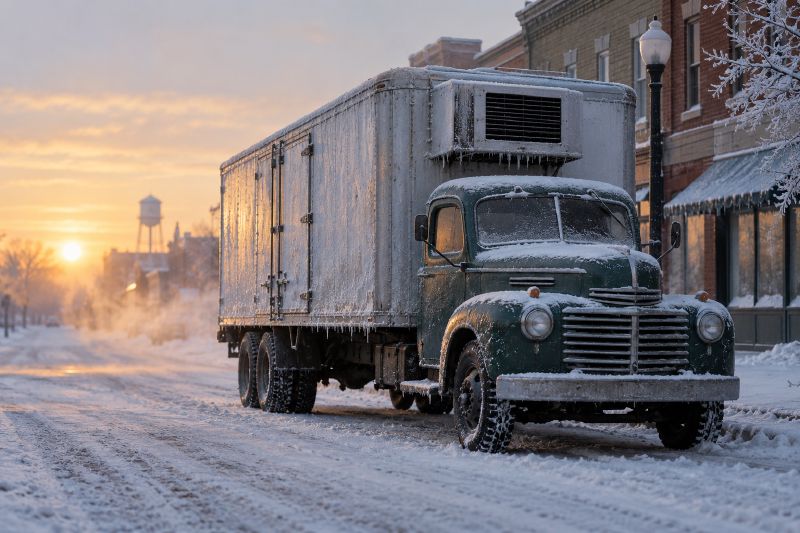
The early units hung under the trailer. The later Model C was the first self-contained unit made to sit on the front wall of a truck or semi-trailer, usually above the cab, and it was lighter and more efficient. ASME has named it an engineering landmark and calls it the earliest known refrigeration unit for trucks.
From lorries to blood banks
During the Second World War, Jones’s portable units kept drugs and blood cold for wounded soldiers, according to the BBC. Jones later became Thermo King’s vice president of engineering.
The scale of what followed is large. ASME says more than three quarters of the food in the United States is now shipped and stored under refrigeration. Jones and Numero received the National Medal of Technology, presented posthumously on September 16, 1991.
The landmark unit itself, serial number 198, went to a wholesaler in Thief River Falls, Minnesota, in 1940. It is now on display at Thermo King’s headquarters in Minneapolis.