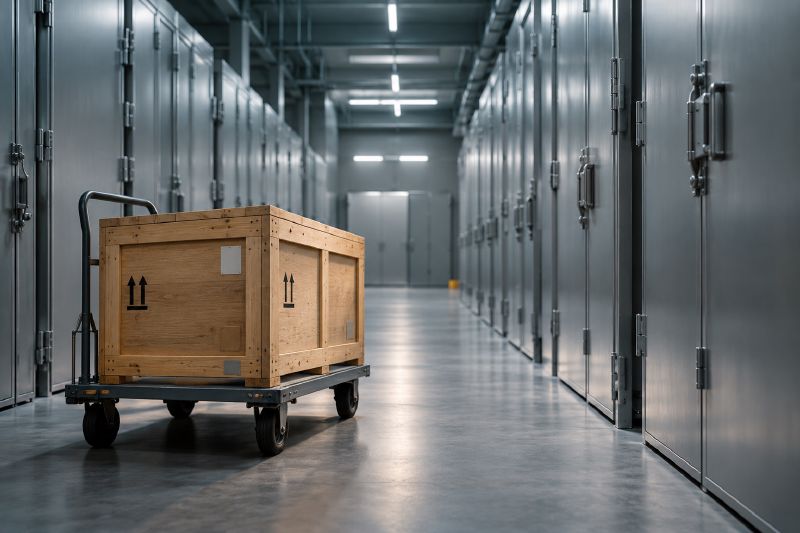
A freeport is a warehouse that customs treats as not quite inside the country. Goods can enter it without paying import duties or taxes such as VAT, because the law treats them as still in transit. The tax falls due only when they reach their final destination, and under the Geneva Freeport’s rules a work of art could in theory stay in that untaxed limbo forever.
That is the whole trick. A painting that never formally arrives never triggers the bill.
From grain sheds to picture vaults
The idea is old. Atossa Araxia Abrahamian, writing in Literary Hub, traces freeports to Italy centuries ago, where merchants used them to store grain at a foreign port without formally importing it. They exist today under many names, including foreign-trade zones and free economic zones, and many sit near an airport, port or border.
The Geneva Freeport began in 1888 as a group of sheds near the waterfront, The New Yorker reported. The local government owns 86% of it. A generation ago its tenants stored cars, wine and gold. More recently the goods have been art, and the storerooms’ contents are said to be insured for $100 billion.
Bonded warehouses were meant for goods passing through. The BBC reported that freeports now hold paintings, precious stones, gold and antiquities for indefinite periods.
Selling without moving
Storage is only half the attraction. Ownership of goods inside a freeport can legally change hands, so large sums can move with no public record of the deal. A painting can be bought and sold several times without leaving the building, and the price, the buyer and the seller need not be disclosed.
Other countries copied Geneva. Singapore opened a large freeport in 2010, and NPR quoted one of its founders saying clients need declare only the broad type of item, with no value, owner or inventory list. The Financial Action Task Force counted roughly 3,000 freeports in 135 countries in 2010, against 100 in 1975, Hyperallergic reported.
Why regulators worry
Secrecy that suits a collector also suits a criminal. After a fatal car crash in 1995, Italian police traced looted Greek, Roman and Etruscan antiquities to a Geneva Freeport storeroom leased by the dealer Giacomo Medici. The case led Switzerland to regulate the storage of ancient artefacts and let police inspect the warehouse.
In 2016 Swiss investigators raided the Geneva Freeport and seized Amedeo Modigliani’s Seated Man with a Cane, whose ownership was disputed.
The European Parliament’s committee on financial crime visited Le Freeport in Luxembourg and concluded that freeports could enable money laundering by sidestepping international transparency rules. The MEP Anamaria Gomes told the BBC the checks she saw were extremely perfunctory. The BBC said Le Freeport was built in 2013, while Hyperallergic reported it opened in August 2014.
Its majority shareholder, the art dealer Yves Bouvier, rejected the criticism. He told the BBC that customs checked every item entering and leaving and that all beneficial owners had to be identified. Luxembourg’s 2015 anti-money-laundering law already required freeports to name the beneficial owner of stored goods, Hyperallergic reported.
Whether that closes the gap is the open question. A rule can name the owner of a crate, but it cannot make a painting leave the building.