For each of the roughly two billion stars it tracked, the European Space Agency’s Gaia satellite recorded a position on the sky, a distance, and the direction and speed at which the star travels. One of the researchers who turns that stream of readings into a catalogue, Stefan Jordan of the University of Heidelberg, has said each star’s file holds “only five parameters for astrometry”, covering position and motion. Brightness and colour come on top of that, giving an estimate of temperature and composition, and a Doppler-shift reading of speed toward or away from Earth.
Put together, those numbers do something a photograph cannot: they let astronomers run the galaxy’s history backward and forward, star by star. Gaia’s camera, the largest flown in space, held nearly a billion pixels across 106 sensors.
Why distance was the hard part
A position on the sky is comparatively easy to fix: point a telescope and read off two coordinates. Distance is not. Parallax, the apparent shift of a nearby object against a more distant backdrop as the observer’s own position changes, is the only method that measures distance directly rather than by inference.
As late as the early 1990s, only about 8,000 stars had accurately known positions. Gaia’s predecessor, the Hipparcos satellite launched in 1989, pushed that to high-precision data for about 118,000 stars, plus lower-precision data for a further 2.5 million. Gaia outstripped Hipparcos by a factor of a thousand, and measured 200 times more precisely.
Jos de Bruijne, Gaia’s deputy project scientist at the European Space Agency, compared the task to working out the shape of a building from inside it. Gaia’s answer was to measure parallax for roughly a billion objects, 99 percent of which had never been measured accurately before.
Why one pass was never going to be enough
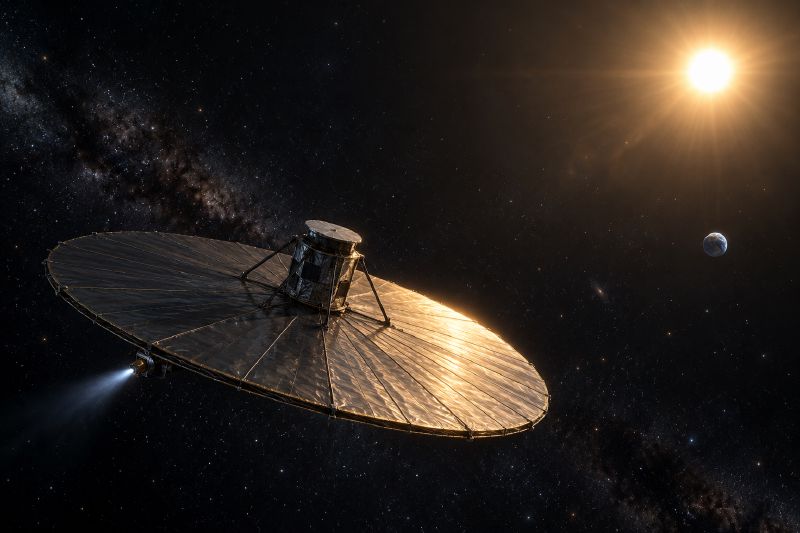
Gaia launched from Kourou, French Guiana, on 19 December 2013, and reached its working orbit at the Sun-Earth L2 point, 1.5 million kilometres from Earth, on 8 January 2014. Its main science run began that July.
From there it spun once every six hours, sweeping two telescopes, pointed about 106 degrees apart, across the entire sky. The spacecraft also precessed slowly around its own axis, completing a full circuit every 63 days, so its field of view drifted rather than repeated the same track. Between the spin and the drift, each of Gaia’s roughly two billion target stars came back into view around 14 times a year, an average of 70 times across the five-year primary mission. A single sighting fixes a position. A star seen dozens of times, over years, gives up its distance and its motion as well.
Observing was only half the job. Behind it, the Gaia Data Processing and Analysis Consortium, more than 400 researchers and engineers spread across six supercomputing centres in Europe, spent years calibrating and checking each batch before release. The first public catalogue, positions and brightness for about a billion stars, appeared on 14 September 2016. A second, covering 1.7 billion stars, followed on 25 April 2018. Gaia has released four batches, each holding more precise measurements than the last. The final catalogue will run past a petabyte, enough that, printed on paper, it would stack 60 miles high.
What the census turned up
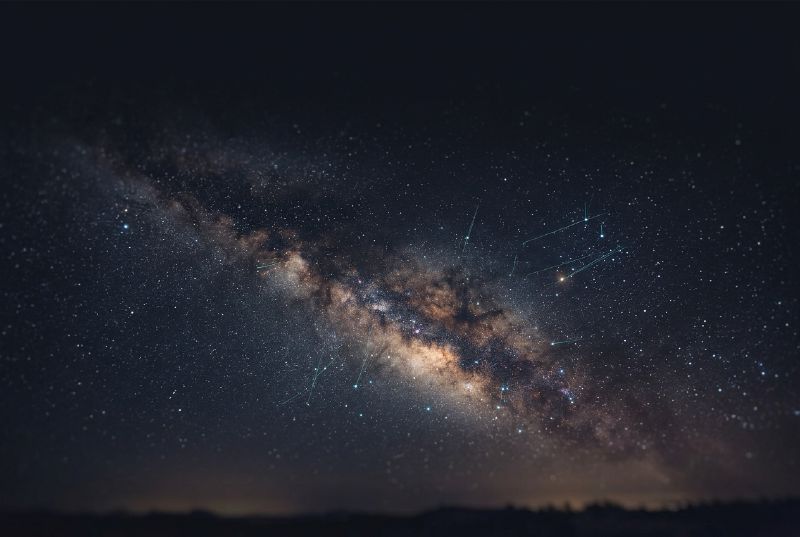
Gaia’s data let astronomers run what amounts to a census of the Milky Way’s star clusters, the groups of stars born together that later drift apart. Watching whether stars in a suspected cluster all moved the same way, and whether their light matched a common age and distance, let researchers sort real clusters from stars that merely happen to line up as seen from Earth. Antonella Vallenari of Padova Astronomical Observatory, deputy chair of the Gaia data consortium, said the survey lets scientists “remove rogue stars that don’t actually belong” to a cluster’s true membership. Gaia data turned up new clusters as small as a few pairs of co-moving stars. New models also revealed one family of stars leaving home in a haphazard scatter rather than the coordinated drift astronomers expected of stars born together.
Away from clusters, Gaia’s three-dimensional and six-dimensional sky maps, tracking position and velocity together, charted dark molecular clouds and stellar streams near the Sun. The wider catalogue has also traced ancient collisions that shaped the Milky Way’s current structure, and the gravitational pull its dark matter exerts on ordinary stars. Along the way it turned up brown dwarfs, quasars, and at least one exoplanet, and peered faintly enough, to 20th magnitude, to pick out stars in the small galaxies orbiting the Milky Way. Separately, it has catalogued the orbits of known asteroids and logged the behaviour of binary star systems.
What is still unopened
Gaia took its last image on 15 January 2025, fired its thrusters to leave its post at L2 for a quiet orbit around the Sun, and went dark on 27 March. It left behind some three trillion observations of some two billion stars, gathered over more than a decade of watching.
Less than a third of Gaia’s data has been released so far. The clusters, the collisions and the wandering family of stars all come from a dataset that is still mostly unreleased.