Gerald Holtom, a designer and wartime conscientious objector, drew the peace symbol for a 1958 march against Britain’s nuclear weapons programme. The Direct Action Committee Against Nuclear War had asked him to design banners and placards for a walk from London to the Atomic Weapons Research Establishment at Aldermaston, and Holtom gave them a symbol to carry as well.
He first considered a cross. Holtom later wrote that he had considered the Christian cross as the march’s central image, then rejected it, arguing that the cross had been co-opted by “crusading tyranny culminating in Belsen and Hiroshima”. He rejected a dove too, on the grounds that Stalin’s government had already used one to put a peaceable face on its own bomb programme.
What the symbol shows
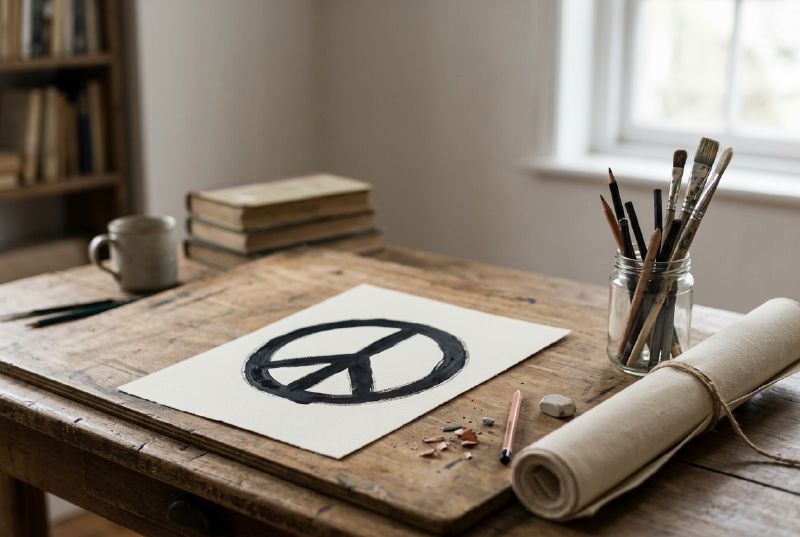
The design combines two letters from semaphore, the flag-signalling alphabet. Both flags held down and angled out from the body forms the letter N. One flag pointing up and the other pointing down forms D. Holtom placed N over D, for nuclear disarmament, inside a circle standing for the Earth.
Holtom gave the shape a second meaning as well. He described it as a human figure in despair, arms flung downward and outward “in the manner of Goya’s peasant before the firing squad”. By his own account he was in “deep despair” when he drew it, and he made a drawing of it the size of a sixpence and pinned it to his lapel.
Sketches Holtom produced for the Aldermaston march committee survive today. Michael Randle, a member of the committee that adopted the design, wrote that Holtom brought drawings showing not just the symbol but how it should be carried: some marchers with long banners stretching across the street, others with individual “lollipop” placards on sticks. The originals passed to the University of Bradford, where the Commonweal Collection holds them.
From a march to a movement
The march set off from Trafalgar Square on Good Friday 1958 and covered 52 miles to Aldermaston. About 500 of the new symbols went with it, carried by marchers organised by the Direct Action Committee, with the Campaign for Nuclear Disarmament joining in. CND adopted the symbol formally within months of the march.
Eric Austin of the Kensington CND branch in London made the first official badges, in white clay with the design in black paint. CND says they went out with a note explaining that fired pottery badges would be among the few human artefacts to survive a nuclear war.
How it left Britain
The symbol’s route to the United States has more than one telling. One account credits Bayard Rustin with carrying it back across the Atlantic. Rustin was a Black pacifist and civil rights organiser who had studied Gandhi’s approach to non-violence, and he took part in the Aldermaston march himself. In just over a decade, according to the peace symbol historian Ken Kolsbun, the sign had travelled from civil rights marches to psychedelic murals on Volkswagens in San Francisco to the helmets of American soldiers in Vietnam.
Kolsbun, who corresponded with Holtom until the designer’s death in 1985, said Holtom came to regret the symbol’s association with despair. Holtom had wanted the arms inverted to point upward, in line with the semaphore flag position for U, as in “unilateral” disarmament, because he thought peace was something to celebrate rather than mourn.
What happened to the design after
The symbol picked up new audiences and new enemies as it spread. Kolsbun documented its adoption by the civil rights movement, then by the hippie counter-culture, and later by the environmental, women’s and gay rights movements. Groups opposed to those causes tried, in turn, to twist its meaning against them. The John Birch Society published pamphlets in 1970 likening it to an inverted, broken cross, and the government of South Africa tried to ban its use by opponents of apartheid in 1973.
CND has never trademarked the design. The organisation’s position, as reported by the BBC, is that a symbol of freedom should remain free for anyone to use, and the sign has since appeared on everything from mugs and rings to a US postage stamp chosen by public vote to represent the 1960s. Lawrence Wittner, a historian of peace movements at the University at Albany, has called it “still the dominant peace sign”.