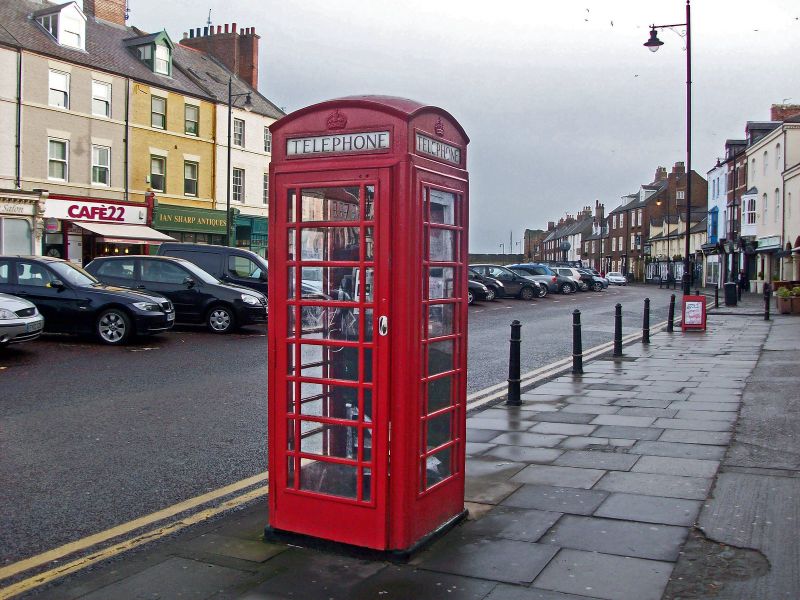
Giles Gilbert Scott won a 1924 competition to design a standard telephone kiosk for Britain, and he wanted it painted silver. The boxes were painted red instead.
more
Scott was already known for large public buildings. He designed Battersea Power Station, Liverpool Cathedral and Bankside Power Station, the building that later became Tate Modern. His winning kiosk, known as Kiosk No. 2 or K2, combined a mass-produced structure with a domed, perforated crown that gave the box proper ventilation.
From K2 to K6
K2 was produced exclusively for the London area. A smaller, cheaper version followed in 1936: the K6, commissioned to mark the Silver Jubilee of King George V’s coronation. More than 8,000 K6 boxes went up in towns and villages across the country, because organisers decided kiosks should reach every place with a post office, regardless of cost. It became the first standard telephone box installed nationwide, rather than concentrated in the capital.
The red box that most people picture is one of these two designs, K2 or K6, not the boxes that came before them. Earlier British kiosks had no single design at all. Some rural boxes looked like thatched huts, and streets carried what the architectural historian Alan Powers has called a “charming riot” of local variation.
Why the boxes disappeared
BT replaced Scott’s kiosks from the mid-1980s with a design called the KX100. Powers, who led a 1980s campaign against the newcomers, said “nobody has made a worthy successor to Scott’s”.
The decline continued as mobile phones spread. By the time of a BT review reported by the BBC, public payphone use had almost halved over three years and revenue had dropped by 40%. BT then planned to cut around 10,000 boxes from its network of 72,000 across England, Scotland and Wales over the following 18 months. The Guardian reported that, according to the regulator Oftel, only 2 million people a day were still making calls from public phones.
Around 2,500 kiosks have been given listed status. The K6 was smaller and cheaper, and it was the version that made Scott’s red box a fixture of British streets rather than just London’s.