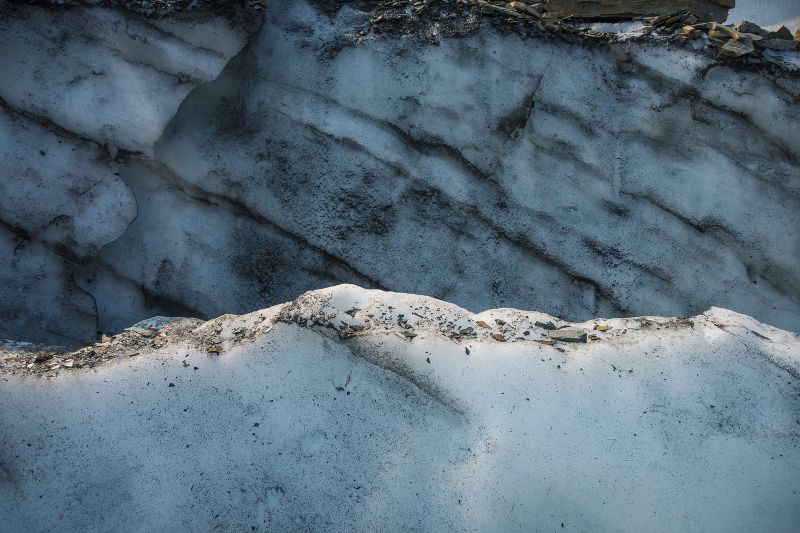
Snow traps air as it falls, and the next snowfall buries it. Pressure then turns the pile into ice with the air sealed inside. A glacier is a stack of these years, and a cylinder drilled out of it is a record of the sky.
more
Scientists call that cylinder an ice core. Cores usually run 300 to 500 feet long.
One layer for each year
Glaciers have annual layers, much like tree rings. Near the surface, a year of snow may add a few feet. Hundreds of feet down, the weight of the ice squeezes a whole century into less than an inch.
The layers keep more than air. Lead pollution spikes at the height of the Roman Empire, and the Chernobyl accident left a layer of radioactive caesium. Black carbon and burned plant sugars show how forest fires rose and fell around the world.
How bubbles give a temperature
The ratio of oxygen and hydrogen isotopes in the ice reveals the air temperature when the snow fell. The gas in each bubble shows how much carbon dioxide the atmosphere held at the time.
Put the two together and you can compare warmth with carbon dioxide across thousands of years. Chris Rapley, then director of London’s Science Museum, said in 2010 that the two are locked together in a “coupled system”.
Depth sets the age. Rapley said that cores drilled several kilometres down hold ice almost a million years old. BBC Bitesize puts the yearly temperature record at 400,000 years.
Why melt threatens the record
Margit Schwikowski flew to Switzerland’s Corbassière glacier in 2020. At 4,100 metres the air should have been below freezing, but her team sweated and the snow was sticky. Back in the lab she found that meltwater had trickled down and washed out the aerosols she uses to date forest fires.
Dorothea Moser of the British Antarctic Survey compares a melt-affected core to a book with tea spilled across its pages. Such cores often show translucent rings.
The loss is not new. Ellen Mosley-Thompson’s team drilled to bedrock on Mount Kilimanjaro in 2000. They found ice from the 1950s at the top, so five decades of snow had vanished.
A vault in Antarctica
In 2015, the glaciologist Jérôme Chappellaz and the chemist Carlo Barbante set up the Ice Memory Foundation. It aims to take cores from 20 glaciers in 20 years.
The first cores to reach the foundation’s Ice Memory Sanctuary came from Col du Dôme on Mont Blanc and from Switzerland’s Grand Combin. Together they weigh 1.7 tons. The sanctuary is an ice cave at Concordia Station, which France and Italy run in Antarctica. For each core, a second sample goes to a university or research institute.
Thomas Stocker, the foundation’s chair, says scientists in 50 or 100 years will have tools nobody can imagine now. He thinks they may learn how air and water move around the planet.