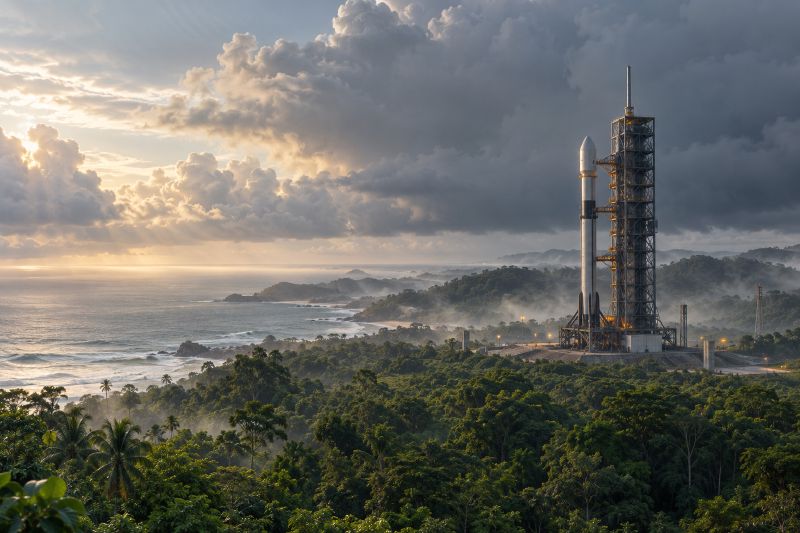
French Guiana became Europe’s spaceport because France went looking for a launch site near the equator and found one there. In 1964 the French government chose Kourou from 14 candidate sites. When the European Space Agency (ESA) formed in 1975, France offered to share the base with it.
The site sits at latitude 5°3’, just over 500 kilometres north of the equator. That position is worth money on every launch.
What the equator gives a rocket
A rocket launched east from Kourou gains an extra 460 metres a second from Earth’s rotation, according to ESA. The boost saves fuel, and a satellite that arrives with more fuel to spare lasts longer in orbit.
Kourou also suits geostationary orbit, because a satellite launched there needs few changes to its path. Its launch angle of 102° lets it fly missions anywhere from east to north.
How France chose it
The French space agency CNES began searching in 1962. Its criteria included political stability, a port and an airport, and enough land to launch safely. Prime Minister Georges Pompidou made the choice official on April 14, 1964.
Safety weighed as much as speed. About 90% of French Guiana is forest, and few people live there. The region faces no risk of cyclones or earthquakes. Its coast puts the open ocean under the flight path of rockets heading north and east, away from towns.
About 16 kilometres offshore lies Devil’s Island, a French penal colony from 1852 to 1953.
From sounding rockets to Webb
The first launch came in April 1968, a French Veronique sounding rocket. The Diamant B followed from 1970 and the European Europa launcher in 1971, before the Ariane series took over.
ESA now pays two thirds of the spaceport’s annual budget. It has spent more than €2 billion on the ground facilities there. The base also launches for customers in the United States, Japan, Canada, India and Brazil.
The site had hosted more than 240 launches since 1990 by late 2021, NASA counted. The James Webb Space Telescope arrived that October by ship, through the Panama Canal and up the Kourou River. The river mouth had to be dredged so the ship could reach port.