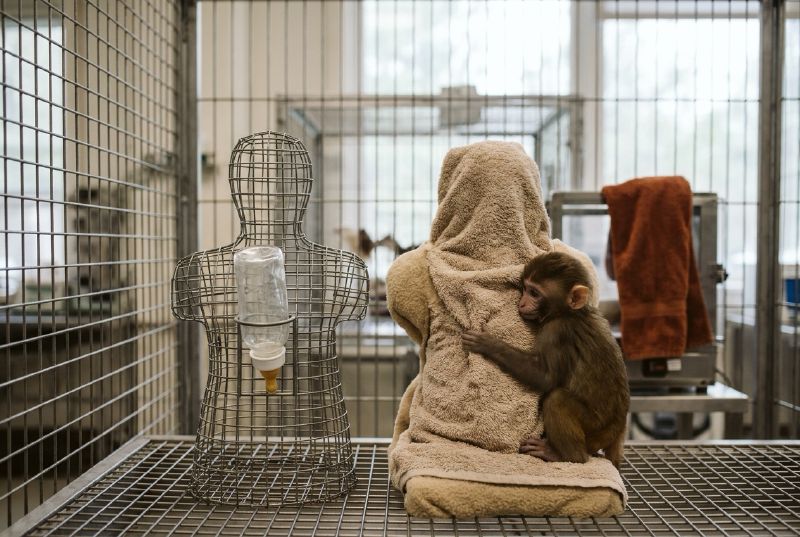
Harry Harlow’s infant monkeys chose the soft mother. He gave baby rhesus monkeys two stand-in mothers, one of bare wire and one wrapped in terry cloth. When only the wire one held a bottle, the babies went to it to feed. Then they hurried back to cling to the cloth one.
The set-up
Harlow ran the work at the primate laboratory of the University of Wisconsin in the 1950s and 1960s. He took infants from their mothers soon after birth. The wire figure was built from wire and wood. The other was covered in foam rubber and terry cloth. Harlow named them the “feeding mother” and the “cloth mother”.
The Association for Psychological Science describes two versions of the test. In one, the wire mother carried the milk. In the other, the cloth mother did. Either way, the infants spent far more time on the cloth figure. One summary, quoted by the psychologist Azadeh Aalai in Psychology Today, puts the wire mother’s share at about an hour a day.
What fear showed
Harlow then frightened the infants. Monkeys with both figures ran to the cloth one, clung on, and then went back to look at the thing that had scared them. Given a noisy toy, an infant with a surrogate nearby would explore it and even attack it. Without a surrogate, the infant cowered.
Monkeys raised with only the wire mother fared worse. In a passage the British Psychological Society quotes, Harlow wrote that they ran to it but did not hug it. Instead they rocked, clutched themselves or rubbed against the cage wall.
Why it mattered in the 1950s
At the time, behaviourists and psychoanalysts dominated American psychology. Both camps held that a baby bonds with its mother because she feeds it. Harlow concluded instead that contact comfort did more for a sense of safety than food did. He argued that the result also said something about people. Claudia Hammond’s 2009 Radio 4 series Mind Changers said the study went on to change how people raise children.
The cost to the monkeys
The same programme asked Roger Fouts, a psychology professor, about the cruelty of the work. Harlow also kept some infants in full isolation. Those monkeys stared blankly, circled their cages and harmed themselves, the APS reports. Some died after they refused to eat.
Aalai notes that some isolation lasted up to the whole first year of an infant’s life. Harlow still won a national medal of science and became president of the American Psychological Association. In her account, that same body later ended his line of work on ethical grounds in the 1980s.
Harlow himself praised the cloth figure as always there and endlessly patient, a mother that never bit or scolded. Writing for the BPS in 2026, Frauke Uhlenbruch read that praise as a warning about chatbots sold as caring companions.