Hebrew had no native speakers for close to 2,000 years. Jews prayed in it, studied it, and wrote in it, but nobody grew up speaking it at home. Many credit Eliezer Ben Yehuda with changing that, and the clearest sign of how strange the change felt is what it did to his own son.
more
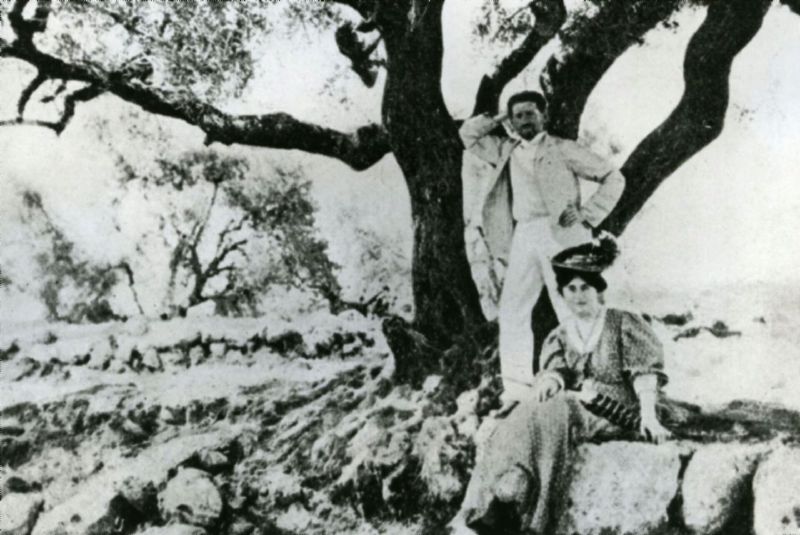
Itamar Ben Avi grew up home-schooled and kept away from other children, so that Hebrew would be the only language he ever heard. For a long time his parents feared he would never speak at all. He said his first Hebrew word at three and a half, and became, by most accounts, the language’s first native speaker in almost two millennia.
Why didn’t Jewish settlers in Palestine speak Yiddish?
Ben Yehuda’s project needed a receptive audience, and Palestine’s Jewish population from the 1880s was anything but linguistically unified. Settlers arriving from the Jewish diaspora in eastern Europe carried Yiddish, while Jewish communities already established in the region spoke Judeo-Spanish, Palestinian and North African Arabic, Georgian, and Tartar. Yiddish was shared by the largest number of them, and on numbers alone it might have become the common tongue.
It didn’t, because many educators treated Yiddish as a mark of the exile they wanted to leave behind, unsuited to a school or a scholarly text. Hebrew carried the opposite meaning. The historian Moshe Nahir writes that Palestine’s Jewish intellectuals saw reviving the language as necessary to national revival in what they viewed as their ancient homeland.
Hebrew also came with a head start. Jewish men and boys already studied Hebrew texts as part of religious schooling. Secular readers had been meeting the language for a century, too, in the literature of the Haskalah, the Jewish Enlightenment.
A generation of children finished what he started
Argument alone does not make a population switch language. Schools did that, through immersion. Some children spent a year or two in Hebrew-only “preparatory” classes before starting first grade, and Hebrew took hold there as the prestigious language of the playground rather than a subject to study. Those children then went home and corrected their parents, or pushed them to enrol in Hebrew classes of their own. By the time that generation had families, Hebrew was the language spoken in the house rather than one heard only occasionally in it, which made it the mother tongue of the generation that followed.
Modern Hebrew already existed on the page
Spoken Hebrew joined a written revival that had been under way for centuries. Some scholars date the shift from mediaeval to modern Hebrew to the sixteenth century, marked by Azariah dei Rossi’s Me’or Einayim in 1574 and the earliest known Hebrew play, written by Judah Sommo. The same period produced the first Yiddish-Hebrew dictionary, compiled by Elijah Levita. The eighteenth century brought the first Hebrew newspapers, and the quarterly Ha-Me’assef ran from 1784 to 1829, carrying work from writers of the Haskalah. The first regular Hebrew weekly, Ha-Maggid, began publishing in Russia in 1856.
Those writers, the maskilim of the Haskalah, viewed Rabbinic Hebrew with disdain, as full of Aramaisms and grammatical errors. They blamed its sorry state partly on Arabic’s influence in mediaeval philosophy and on what they called the corrupt Yiddish language.
A language still short of words
Reviving Hebrew as an everyday language exposed a gap the written revival had never had to close: the Bible has words for love, war and peace, but none for ice cream, jelly or underwear. Ben Yehuda and his circle built the missing vocabulary from old Hebrew roots. The body that carries on that work today, the Academy of the Hebrew Language, still adds roughly 20 words a year officially. Hundreds more get counted once technical vocabulary and jargon are included.
The academy runs a public hotline for word questions, answered in part by an enthusiast named Keren Dubnov, who once turned down a child’s invented word for a traffic light stuck flashing amber. She liked it, she said, but nobody needed it. Language still runs hot enough in Israel to reach the Knesset: in 2005, prime minister Ariel Sharon criticised Israelis for signing off with “yala bay,” an Arabic-English hybrid, and told them to say “shalom” instead.