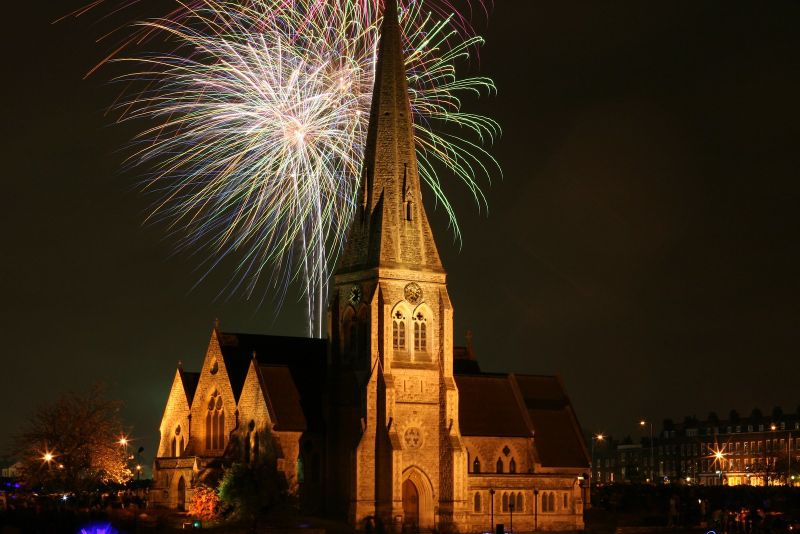
Bonfire Night began as a legal duty. A year earlier, Guy Fawkes had been found in a cellar under the House of Lords with 36 barrels of gunpowder. In 1606, after Londoners lit bonfires for King James I’s escape, an Act of Parliament decreed that 5 November be celebrated every year. That law stayed in force until 1859. Four centuries on, the bonfires still burn, though the law behind them no longer stands.
more
What the plotters planned
The Gunpowder Plot was the work of a small group of Catholics, led by the Warwickshire gentleman Robert Catesby. They wanted to kill James I and restore a Catholic monarch to the English throne. James had raised the penalties on Catholics who refused to attend Protestant services, after early hopes that his reign would ease their persecution. Catesby’s group rented a cellar beneath the House of Lords and packed it with gunpowder. They timed it for the state opening of parliament on 5 November 1605, when the king and most of his government would sit in the chamber above.
Guy Fawkes, posing as a servant called John Johnson, was the plotter who sourced the gunpowder and stayed with it. Had the plan worked, the explosion would have killed the king, his family, his councillors and the members of both houses in one blast.
The letter that stopped it
The plot failed because of an anonymous letter. On 26 October 1605, Lord Monteagle received a warning not to attend the opening of parliament, telling him that the assembly would “recyeve a terrible blowe” without anyone seeing who had struck it. Monteagle handed the letter to Robert Cecil, who waited before acting.
Cecil ordered a search of the parliament buildings on 4 November. Searchers found Fawkes in the cellar that night, dressed for a quick escape, with spurs already on his boots. Guards took him to the Tower of London, where he was tortured for two days before he confessed. James I had personally authorised the escalation. He ordered that “the gentler tortures are to be first used unto him” before harsher methods followed.
The remaining plotters fled and tried to raise a Catholic uprising, but got no support. At Holbeche House in Staffordshire, the king’s men caught up with them, and Catesby was among those who died in the fighting. The survivors, including Fawkes, stood trial in London. Eight men, Fawkes among them, were hanged, drawn and quartered on 30 and 31 January 1606. Even the plotters killed at Holbeche House were exhumed and decapitated after the fact.
How the anniversary became law
Once the plot had failed, Londoners were encouraged to light bonfires in celebration of the king’s survival. Parliament turned that response into the 1606 Thanksgiving Act, which decreed that 5 November should be kept as an annual day of thanksgiving from then on. The obligation stood for two and a half centuries before it was repealed in 1859.
The plot’s documents, including the Monteagle letter and one of Fawkes’s seven confessions, were kept for centuries in a leather bag known as the Bag of Secrets, under lock and key. They surfaced in public in 2022, when the National Archives at Kew put the original letter on display for the first time, as part of an exhibition on treason that opened, fittingly, on 5 November.
What the plot left behind
The failed plot had consequences well beyond the calendar. In its aftermath, James I’s government passed new laws stripping Catholics of the right to vote.
The rhyme still recited every November, warning that “gunpowder, treason and plot” should never be forgot, is the part of the story that survived intact. The law that once compelled the celebration is gone.