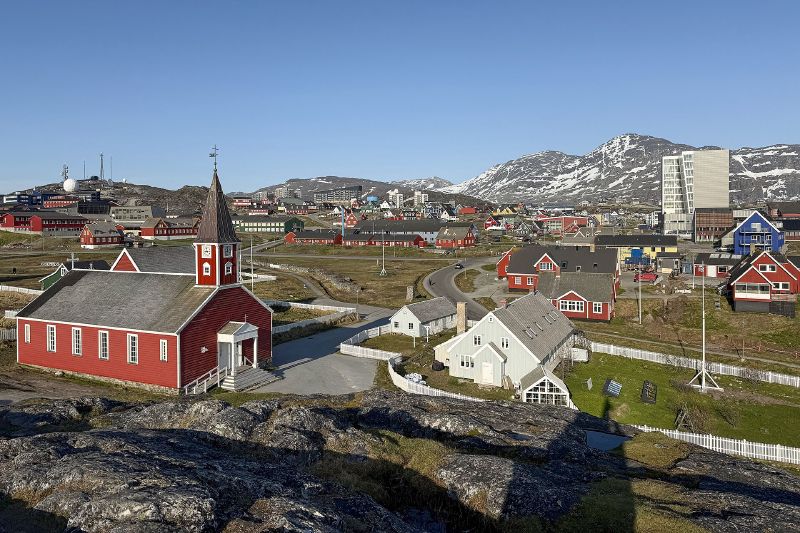
Greenland became Danish in three steps. A missionary founded a settlement at Nuuk in 1721, a treaty made the island a Danish colony in 1814, and in 1953 it stopped being a colony and became part of the Kingdom of Denmark itself.
more
The man at the start was Hans Egede, a Danish-Norwegian Protestant missionary. A 7ft bronze of him still stands on a hill above Nuuk’s cathedral. In the late 1970s somebody covered it in red paint, the BBC’s correspondent recalls from his school days in the town.
Who was there first
Egede did not arrive on an empty island. Geographical dates the first known inhabitants, the Saqqaq people, to about 2500 BCE. The Thule culture, ancestors of today’s Inuit Greenlanders, spread across the Arctic around 1000 CE.
Norse settlers came too. Erik the Red, exiled from Iceland, landed in about 985 and named the island Green Land to draw others after him. In 1261 the Norse settlements passed to the Norwegian crown, according to the National Geographic Education Blog. By the 15th century the Norse colonies had disappeared, and the Inuit remained.
From mission to colony
Egede’s mission began continuous Danish involvement in 1721. At the time Denmark and Norway shared a crown. When the Treaty of Kiel ended that union in 1814, Greenland stayed with Denmark as a colony.
The BBC’s writer, a Dane, says his compatriots long saw themselves as the world’s nicest imperialists. That self-image has worn thin. A joint Danish and Greenlandic inquiry is examining a contraceptive campaign. Reports say that from 1966 to 1970 nearly half of Greenlandic women who could bear children were fitted with coils, often without consent.
From colony to home rule
In 1953 Greenland ceased to be a colony. It became part of the kingdom, with seats in the Danish parliament. Home rule followed in 1979, handing Greenland its own schools, health service and fisheries.
Self-government came in 2009. National Geographic’s blog put the yes vote at 76%. Kalaallisut, the Inuit language, became the official language. Denmark kept foreign and defence policy, though Greenland can make international agreements where it holds the powers at home.
Where it stands now
The link still runs on money as well as law. In 2009 the island relied on fish exports and an annual Danish subsidy of $637 million.
Donald Trump’s talk of taking the island has put the question back on the table. The Danish prime minister, Mette Frederiksen, answered that “Greenland belongs to the Greenlanders.” One poll cited by the BBC found 85% of Greenlanders against joining the US. Polls in recent years show about two-thirds of islanders wanting independence.