The false story began with a magazine feature in 1945 and a name people already knew. The Ladies’ Home Journal showed B. F. Skinner’s baby daughter inside a glass-fronted crib he had built. Readers who knew the Skinner box, his chamber for training rats and pigeons, assumed the crib was one too. Over the following years the rumour grew that the girl had been harmed by it. She was not.
What Skinner actually built
In 1944 Skinner and his wife, Yvonne, were expecting their second child. They lived in Minnesota, and keeping a baby warm there meant layers of clothes and blankets. The Association for Psychological Science (APS) notes that the layers limited how a baby could move. A bundled baby could also overheat, and the parents faced more washing.
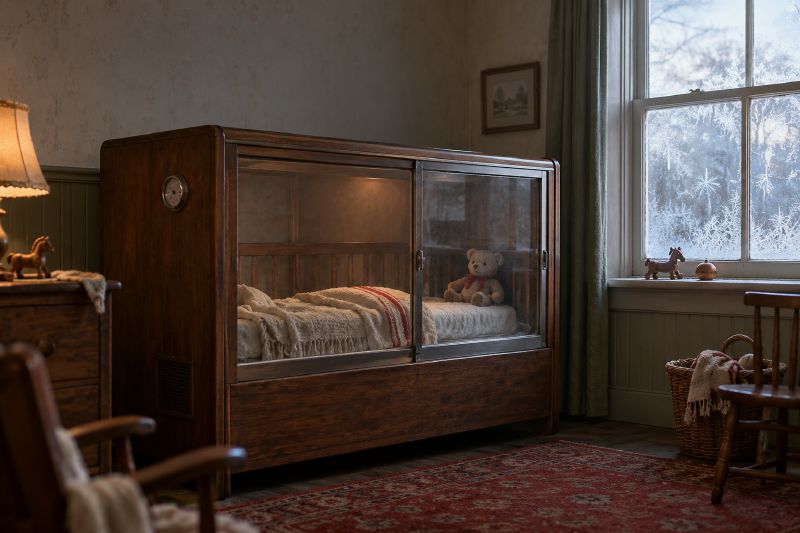
Skinner’s answer was what he called the air crib. It was a large metal crib with a roof and three solid walls. A pane of safety glass formed the front and slid down so a parent could lift the baby out. The floor was stretched canvas, with a roll of sheeting on top that could be wound on when soiled. A control box on the roof set the temperature and humidity, and filtered air came in from below.
Robert Epstein, writing in Psychology Today in 1995, called it the first room sized for a baby. It stood at waist height, so it doubled as a changing table. Its first occupant was Skinner’s daughter Deborah. She slept and played in it for her first two years.
How a magazine feature went wrong
The crib’s public debut came in the Ladies’ Home Journal in October 1945. The APS gives the feature’s title as “Baby in a Box”. Epstein quotes a different headline from it: “The Machine Age Comes to the Nursery!” A psychiatrist in the piece praised the crib as a “tremendously interesting idea”.
Three things in it probably hurt, according to the APS. The first was the title. The second was Skinner’s own word for the arrangement, an “experiment”. The third was the photograph, which showed Deborah behind the glass with her face and hands pressed against it.
Other outlets then reprinted parts of the article. Many readers saw only fragments and never read the whole account.
Where the Skinner box came in
Skinner was already famous for small lab chambers used to study rats and pigeons. People called these Skinner boxes. Some readers merged the two devices and decided Skinner was running experiments on his own children, Epstein writes. The APS says the crib came to be linked in people’s minds with levers and food pellets.
There was a wider unease too. Some people distrusted any machine that seemed to stand in for a mother’s care, the APS reports.
How the rumour grew
By the 1960s, Epstein writes, the rumour said Deborah was psychotic. Later versions claimed she had sued her father and taken her own life. The APS states plainly that these stories are false. Deborah grew up without harm and has spoken warmly about her childhood and the crib. In 2004 she answered the legend herself in a Guardian article titled “I was not a lab rat”. Epstein’s 1995 piece reported that she had married a professor and was working as an artist in England.
What happened to the air crib
About 300 children were raised in cribs of this kind. Epstein and Michelle Bailey traced more than 50 of them and found the results positive in every case. The children’s health was normal, and their parents liked the crib for its safety, warmth and convenience.
It never caught on all the same. One would-be maker named its version the “Heir Conditioner”. Epstein argued that big companies had little reason to build it, because nobody can patent a small room. The APS adds that firms feared the publicity if anything went wrong. One crib now sits in the Center for the History of Psychology in Akron, Ohio.