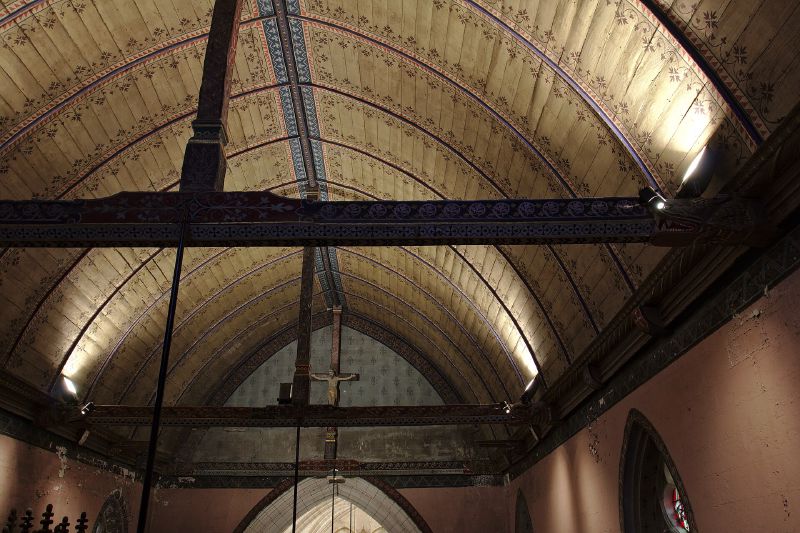
A barrel vault is a round arch drawn out in depth, like a tunnel. According to ArchDaily, it carries a roof by keeping its whole curve in compression, then passing that load down and outwards into an abutment or pillar on each side.
more
Where the weight goes
Paula Pintos, writing in ArchDaily, describes the vault as a run of arches that press evenly through their form. The weight bears down on the crown at the top. Lower down, the curve turns that load sideways, so the base of the vault shoves outwards.
That outward shove must meet an abutment or pillar on each side. Pintos also says a stone or brick vault demands very exact dimensions.
Small bricks, big rooms
The appeal was always the span. Domus notes that the vault let builders roof very large rooms with very small units. It first appeared in Mesopotamia and Egypt, where clay for bricks was plentiful. The oldest known barrel vaults, from around 4000 BC, spanned the Sumerian ziggurat at Nippur, in fired brick set in clay mortar.
Greece largely did without. Its builders worked in large stone blocks and favoured post and lintel instead, according to Domus. Rome took the vault up, and it later returned in Renaissance building. The word itself comes from the vulgar Latin volvitare, meaning to turn or to round.
A second life in concrete
Reinforced concrete and steel revived the form in the 20th century. Louis Kahn built the Kimbell Art Museum in Fort Worth, Texas, finished in 1972, around rows of barrel vaults with skylights running along their tops. Kahn wanted light to arrive from the vault’s high point, “where the light is best”.
Italy alone has more than ninety ribbed industrial vaults of the type known there as paraboloids, Domus reports. Some of them stand empty, waiting for a new use.