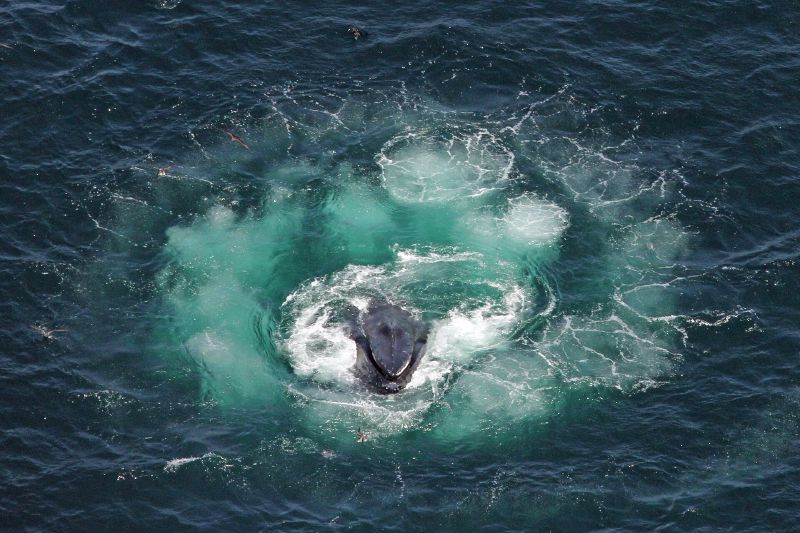
A humpback whale builds its trap out of breath. It dives below a shoal of krill or fish, swims in circles, and lets bubbles out of its blowhole to form a rising curtain. The prey treat that curtain as a wall and bunch together inside it. Then the whale, or a group of whales, surges up through the middle with its mouth open.
more
Krill, herring and young salmon are all on the menu, and whales use the method around the world, sometimes alone and sometimes in teams. People have watched it for decades. How it works under the surface took longer to see.
Tuning the net as it closes
From a boat, a bubble net looks like a messy scatter of foam, according to Andrew Szabo, a marine ecologist who leads the Alaska Whale Foundation. His team wanted the view from inside.
They used poles about 20 feet long to stick suction tags onto whales in northern Southeast Alaska. Each tag carried a 4K camera, a hydrophone and motion sensors, and stayed on for up to 24 hours. Drones filmed the same whales from above. The researchers published the results in Royal Society Open Science on August 21, 2024.
The footage showed solitary whales adjusting the speed and spacing of their bubble bursts. As the ring shrinks, a whale releases bubbles more often, which tightens the mesh the prey could slip through. Lars Bejder of the University of Hawai’i at Manoa, a co-author, described that control to National Geographic. By shaping the net this way, a whale may catch about seven times as much prey in one gulp, on average. Fewer lunges means less energy spent.
Is a bubble net a tool?
Scientists now tend to define a tool as an object, not attached to anything, that an animal uses to change something else. Under that definition the whales make their tool from the water around them. Janet Mann, a marine mammal biologist at Georgetown University, told National Geographic that the Alaska paper strengthens the case for calling it tool use.
That would put humpbacks alongside sea otters that crack clams on rocks and dolphins that wear sponges while they forage.
Why most humpbacks rarely bother
Only about 5 to 10 percent of Alaska’s humpbacks bubble-net feed, Bejder said, and he called it a rarity in every population. In three days of tagging, the team saw 70 to 80 whales at it. A week later the same whales had stopped.
Szabo’s explanation is prey density. A net takes a long time to build, so when food is packed tight it pays to skip it. When prey is thin, a net can turn a patch that was not worth feeding on into one that is.
Learning it from other whales
A study published on January 21 in Proceedings of the Royal Society B suggests that whales pick up the method from each other. Researchers went through field records from the Kitimat Fjord System in northern British Columbia, covering 2004 to 2023.
They identified 526 whales by the markings on their tails. About half of them were seen bubble-net feeding, on 635 occasions, and more than 92 percent of those hunts were group efforts. The pattern pointed to social learning rather than whales each inventing the method alone.
The method spread faster after 2014. That year a marine heatwave known as “the blob” began in the North Pacific and lasted nearly three years, cutting the prey available to humpbacks. The researchers suggest the Kitimat whales leaned on bubble nets to survive. Co-author Éadin O’Mahony of the University of St Andrews argued that losing learned behaviour can harm a population as much as losing whales.
A new sighting off Australia
The behaviour is mostly recorded in some Northern Hemisphere populations. East Australian humpbacks usually feed by lunging on their sides or below the surface.
In September 2020, a drone flown by a citizen scientist filmed a super group of about 33 humpbacks feeding together off New South Wales, some of them using bubble nets. A researcher writing in The Conversation said it was the first bubble-net feeding documented in Australian waters. Some whales from that population are known to bubble-net feed in Antarctica, so the habit may have arrived by cultural transmission or arisen on its own.
Nobody yet knows which. The Kitimat study suggests the answer lies in who those whales have been watching.