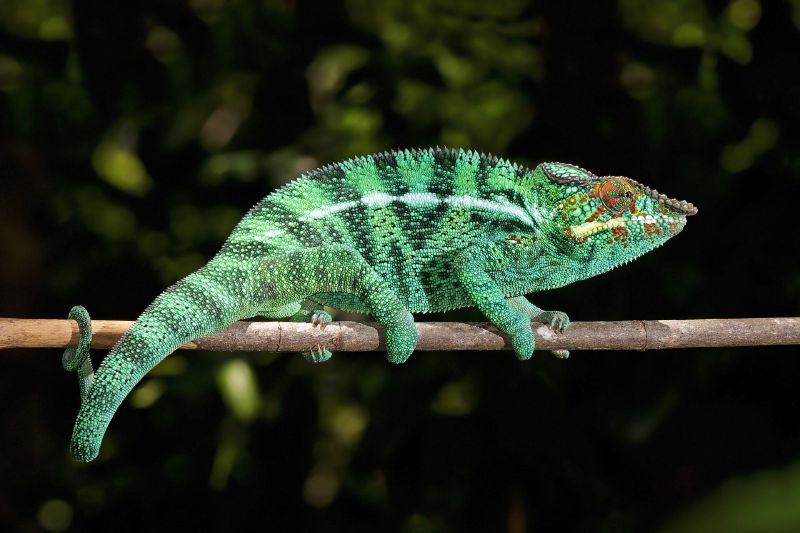
A chameleon changes colour by rearranging crystals inside its skin, not by mixing pigment. A layer of cells called iridophores holds a lattice of guanine nanocrystals, and tuning the spacing of that lattice changes which wavelengths of light bounce back. At rest, the crystals sit close together and reflect blue and green. When the animal is excited, they spread apart and the reflected light shifts towards yellow, orange or red.
more
Researchers at the University of Geneva identified the mechanism in a 2015 study of the panther chameleon, a lizard native to Madagascar. The team, whose senior author was the physicist Michel Milinkovitch, filmed male Furcifer pardalis switching colour during contests and courtship, then matched the pattern against models of how differently spaced crystals would reflect light.
What’s shifting under the skin
A chameleon’s skin holds several layers of colour-producing cells, each doing its own job. The outermost carries xanthophores, which hold yellow pigment, and erythrophores, which hold red, concentrated mainly in the animal’s stripes. Below that sit two layers of iridophores. The upper layer, the one that does the rapid switching, packs its crystals into a tight, regular grid.
When the animal is calm, that tight grid reflects short wavelengths: blues and greens. When a male is challenged or courting, the layer relaxes, the crystals spread further apart, and the reflected colour moves towards yellow, orange and red. Milinkovitch called the effect “a selective mirror”, letting some wavelengths through while bouncing the rest back at the viewer. His team tested the idea directly. Comparing skin from a calm chameleon against skin from the same animal while it was displaying showed the crystal spacing had changed. Putting a skin sample in salty water pulled fluid from the cells and reproduced that same shift in the laboratory.
Green comes from stacking two of these systems. Blue light reflects off the iridophore lattice and passes up through the yellow pigment sitting above it, and the two together read as green to the eye. A second, deeper layer of iridophores holds larger crystals arranged with far less order. Rather than switching colour, this layer bounces back a large share of incoming sunlight, particularly in the near-infrared band, which may help keep the animal cool. Underneath everything sit melanophores, cells that hold the dark pigment melanin in long branching arms reaching toward the surface. Spreading that pigment through the arms darkens the skin, and drawing it back towards the cell body lightens it again, the same trick many fish and reptiles use under stress.
Devi Stuart-Fox studies animal colouration at the University of Melbourne. She called the discovery of two separate iridophore layers “really novel”, since the deeper layer turned out to affect near-infrared reflection as well as the colour a viewer sees.
Why bother changing colour at all
The switch is mostly about signalling rather than hiding. Both sexes of panther chameleon can darken or lighten their skin under stress by spreading or gathering pigment in ordinary chromatophores, a separate system from the crystal lattice. A full change of hue, from green to yellow or orange, is largely a male display. A mature male can shift his background colour within a couple of minutes when he meets a rival or a receptive female, and the change is fully reversible.
The signal is not uniform across the body. A 2013 study of competing males found that a darker head made a male more likely to win a fight, while brighter stripes marked the one likelier to approach his rival first. More broadly, Encyclopaedia Britannica describes a chameleon’s overall colour state as answering to hormones, temperature and the animal’s autonomic nervous system. Light plays a part too, and so does the animal’s emotional state, from fright to the outcome of a contest with another chameleon.
The popular idea that a chameleon changes colour to vanish into its background does not hold up either. Britannica calls matching the background a misconception. A panther chameleon’s everyday green and brown does blend into Madagascar’s coastal forest canopy. That is a side effect of its resting colour, though, rather than the reason it switches to yellow or red at all.
Heat is part of the job too
Colour also works as a thermostat. A cold chameleon turns dark to soak up more heat from the sun, and an overheated one turns pale to throw more of it back off. A 1993 study found chameleons tend to show darker colouring in the morning, which researchers linked to cutting the time an animal needs to spend basking before it can get moving.
The deep, disordered layer of iridophores backs this up at the cellular level. It reflects a good share of the sun’s near-infrared light regardless of what colour the animal shows on top. That lets a chameleon stay hidden most of the time and still put on a vivid show when it needs to, while potentially limiting the heat it absorbs.
Female chameleons can change colour too, but only in a limited way. In panther chameleons, the upper crystal layer is fully developed only in adult males.