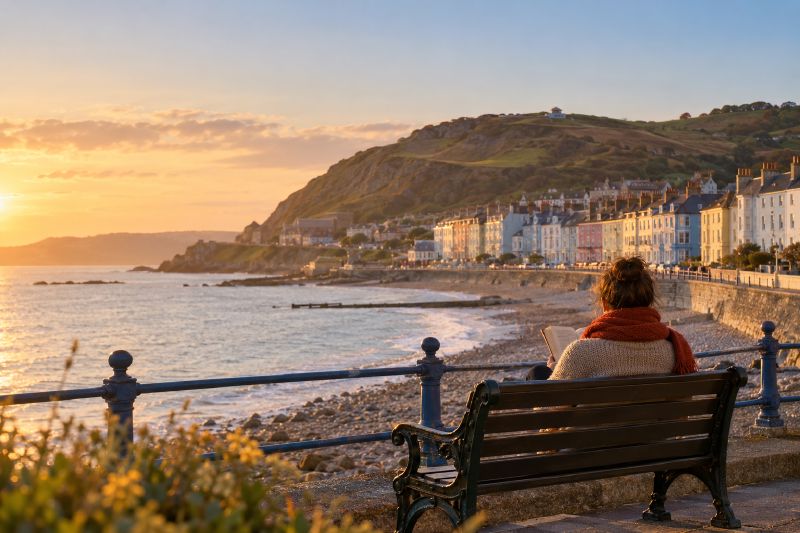
Aberystwyth is a town, yet Unesco has named it Wales’s first City of Literature. The title went to the town together with its county, Ceredigion, which Unesco chose for its literary scene, its universities and national literary bodies, and its bilingual culture.
That points to how the system works. A place does not qualify by size or by a city charter. It qualifies by showing that one creative field runs through its civic life, and by convincing Unesco of it in a bid.
What the literature title asks for
Each field in the network has its own tests. For literature, BBC News lists the quality, quantity and diversity of local publishing, the literary events and festivals a place hosts, and its libraries, bookshops and cultural centres.
AFAR’s fuller list adds education: the quality and quantity of courses that focus on literature. It also asks how far literature, drama or poetry shape everyday life in the city, and how much local media do to promote books.
Aberystwyth’s case shows what that looks like on paper. The Books Council of Wales says the town has a connection to more than 300 poets, and it was the first Welsh town to employ a town poet. Ceredigion also holds the National Library of Wales and Aberystwyth University.
Who puts the bid together
Not Unesco. A local partnership does the work. In Aberystwyth it was Dinas Llên, set up with Welsh government money routed through Ceredigion council. Its partners included the university, the Books Council of Wales and the National Library of Wales.
Euronews reports that Unesco invites applications from cities that treat a form of creativity as a strategic part of sustainable urban development. In other words, a bid has to promise policy, not only point to a heritage.
How big the network is
The Creative Cities Network began in 2004, when Edinburgh became the first City of Literature. By 2024 it had grown to 350 cities in more than 100 countries, Euronews reported.
Literature is one of seven fields. The others are crafts and folk art, design, film, gastronomy, media arts and music.
The literature list grows in batches. In 2023 Unesco added eight more, among them Hobart in Australia and Rio de Janeiro in Brazil, which took the total to 42, according to AFAR. Québec City joined in 2017. Its Maison de la Littérature, a former church turned literature centre, hosts the Québec en Toutes Lettres festival each October, the sort of fixture the tests reward. When Aberystwyth was named, BBC News put the count at more than 50 cities, including Barcelona, Dublin and Seattle.
What a city gets for it
Membership works mostly as negotiating weight. Euronews says members gain access to tested ideas from other cities and can use Unesco’s recognition to lobby. At best, that may bring funding for the field they represent.
Some members value the title for its staying power. Albane Vangheluwe, who represents Ghent as a City of Music, told Euronews that politics changes every five or six years, but a title is protected and keeps projects going. Łukasz Kałebasiak of Katowice said the same holds in Poland, where a change of mayor or party can be sharp.
Members also share projects. At the network’s 16th annual conference in Braga, Portugal, Iaşi in Romania described sending writers into schools, a scheme that spread quickly to ten local secondary schools.
Unesco’s deputy director-general, Ernesto Ottone, framed the network around mayors, because they carry out public policy at local level. Aberystwyth’s mayor, Emlyn Jones, said he hoped the title would draw more creative industries and visitors to the town.