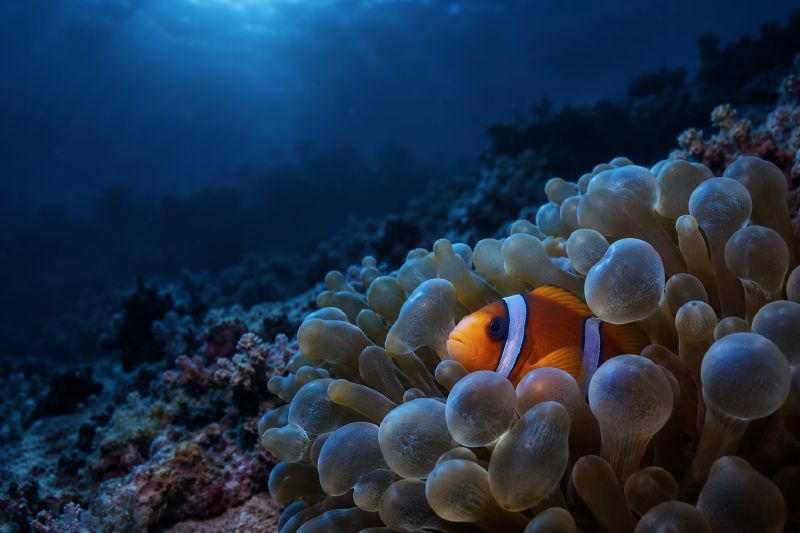
A clownfish and its sea anemone trade protection for housekeeping. The anemone’s stinging cells, called nematocysts, keep predators off the fish, and the fish cleans algae from the anemone. That is the textbook version. Research since has added two more services the fish provides, and one of them happens only in the dark.
NOAA’s staff at the Fagatele Bay National Marine Sanctuary describe the pair as living in a symbiotic, mutually beneficial relationship, with the stinging tentacles no threat to the resident fish.
What the anemone gives
Shelter, mostly. Pixar’s Finding Nemo sent its clownfish across an ocean, but a real one seldom leaves the anemone it lives in. During the day it darts into the open water overhead to snatch scraps of food. At night it settles deep among the tentacles.
A predator that follows it in meets a mass of stinging cells. The fish does not suffer the same fate.
What the fish gives back
For a long time the answer looked like a fair swap of bodyguard duties. The anemone protected the fish, and the fish chased off butterflyfish that would otherwise eat the anemone, National Geographic reported.
Then Nanette Chadwick of Auburn University in Alabama showed that the fish also fertilise their host. Their waste is rich in ammonia, and the anemone puts it to use.
The cleaning noted by NOAA adds a third service: the fish keeps algae from building up on its host.
The night shift
The surprise came in 2013. Chadwick and her student Joseph Szczebak tested an idea scientists had floated for decades without checking: that the fish might help its anemone breathe.
An anemone has little control over the water flowing across its body. It depends on local currents to carry oxygen and nutrients in. Stagnant pockets can form between its tentacles, and they hold back its growth.
Szczebak and Chadwick worked with the two-band clownfish and the bubble-tip anemone, both collected from the Red Sea near Aqaba in Jordan. They separated the partners and measured the oxygen in the water around them. In the dark, the pair together used about 40 per cent more oxygen than the two did apart.
The rise depended on touch. When a mesh barrier let the fish see and smell its anemone but not reach it, oxygen use fell.
What the cameras showed
Infrared filming explained the result. Other marine biologists had said clownfish stay still overnight, but Szczebak’s footage showed them moving for most of the night. The fish wriggled hard to wedge themselves between the tentacles, often turning through 180 degrees as they went, and they never did this with no anemone present.
All that wriggling stirs the water. It opens up the tentacles and pushes fresh water between them, so the anemone takes in more oxygen while the fish burns more through effort. Together those two effects account for the 40 per cent rise.
Other reef fish do something similar. Gobies and damselfish shelter in corals at night, where weak currents leave the water low in oxygen, and both beat their fins faster to move it.
The questions still open
Nobody yet knows exactly why the clownfish dances, National Geographic notes. Szczebak found it was more likely to start when sitting downstream of its anemone, which raises the possibility that the host releases a chemical cue.
Another reading is less generous. Anemones can swell and shrink, and the fish may be making more room for itself, with the fresh water a side effect. The study, by Szczebak, Henry, Al-Horani and Chadwick, appeared in the Journal of Experimental Biology.