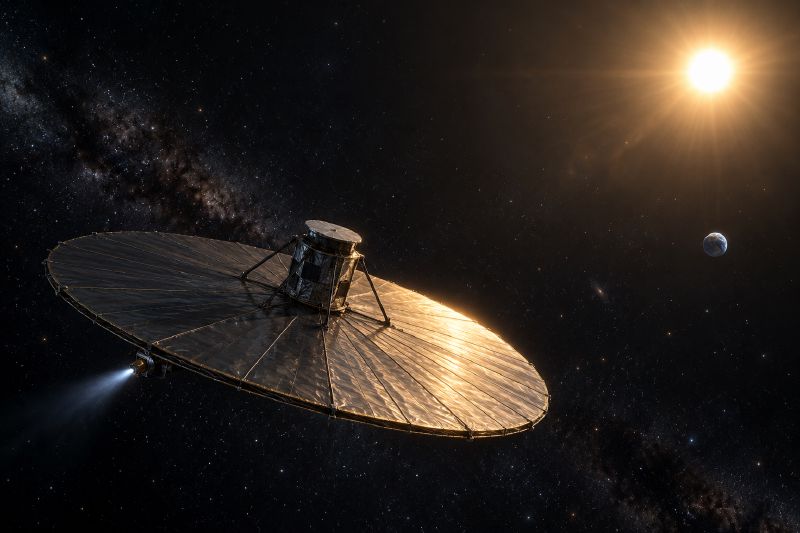
A Lagrange point holds a spacecraft because the gravity of two large bodies balances there. Around the Sun and Earth there are five such points, and a craft placed at one can stay in position while spending very little energy, the German Aerospace Center (DLR) explains.
“Very little” is not “none”. The European Space Agency’s Gaia observatory needed a correcting thruster burn about once a month to keep its place.
Where the balance falls
The Met Office describes a Lagrange point as a place where the pulls of the Sun and Earth cancel out, leaving a gravitational equilibrium. A spacecraft there keeps the same position relative to both bodies as Earth travels round the Sun.
The second point, known as L2, sits 1.5 million kilometres from Earth on the line that runs out from the Sun through our planet. DLR says L2 lets a telescope work clear of Earth’s radiation with an unbroken view of deep space while staying in contact with the ground.
The Earth and the Moon have their own five points. Air & Space Forces Magazine notes that a craft can loiter near them, and move between them, on very little fuel.
Why Gaia still had to steer
Gaia’s post lay on the night side of Earth, about 1.5 million kilometres out, Astronomy Now reported. Gaia did not sit on the point itself. It flew a looping path around it, called a Lissajous orbit, and took about 180 days to complete each loop, Astronomy Now reported.
That path was not stable, so engineers planned a manoeuvre every month to hold it. Even reaching it took care. After launch on a Soyuz rocket on 19 December, Gaia made one burn on 7 January and a smaller one some days later to settle into orbit.
Gaia’s survey was meant to chart the positions and motions of a billion stars, and the camera it carried was the largest yet flown in space. David Milligan, Gaia’s spacecraft operations manager, said the thrusters had to push the craft the right way while keeping the Sun off its delicate instruments.
So the sources differ in tone. The Met Office calls the orbit at a Lagrange point stable. The Gaia team’s own plan shows that, at L2 at least, stable means cheap to hold rather than free.
Who is heading to which point
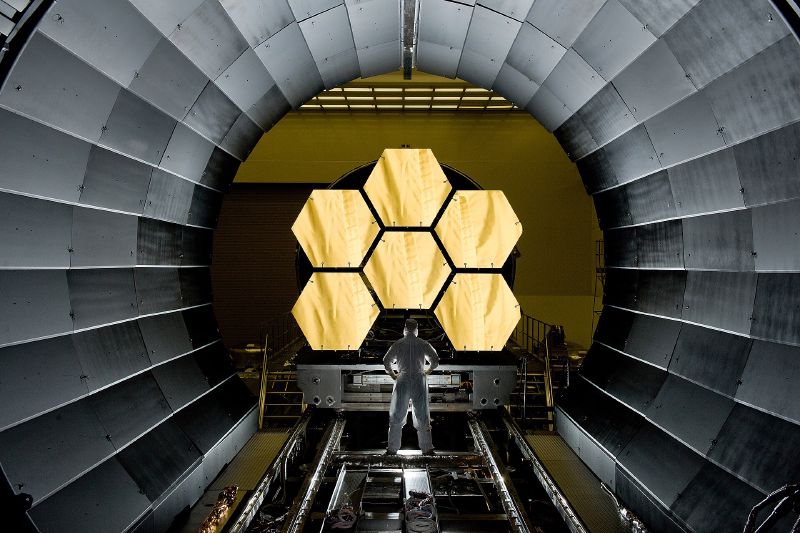
The second point is getting crowded. NASA’s James Webb Space Telescope has worked there since Christmas Day 2021. DLR expects the European PLATO telescope, which will hunt for Earth-like planets with 26 cameras, to join it after a launch on an Ariane 6 rocket.
The fifth point is the target of a space weather mission called Vigil. The UK government confirmed it at an ESA ministerial meeting in November 2022.
That point matters for forecasting because of its angle. A coronal mass ejection, a burst of plasma from the Sun, can reach Earth in 18 to 96 hours. Judging its speed is hard from the L1 point alone, since that view looks straight down the line between Sun and Earth. NASA’s twin STEREO probes, launched in 2006, briefly showed how much a side view helps.
A satellite at L5 would keep that side view all the time, according to the Met Office. Its Space Weather Operations Centre is one of several forecasting centres expected to use the data.
How far away these points are
Scale is the hard part to picture. The Moon averages 238,900 miles from Earth. Air & Space Forces Magazine shrinks Earth to a basketball under one hoop, which puts the Moon at the top of the three-point line as a tennis ball.