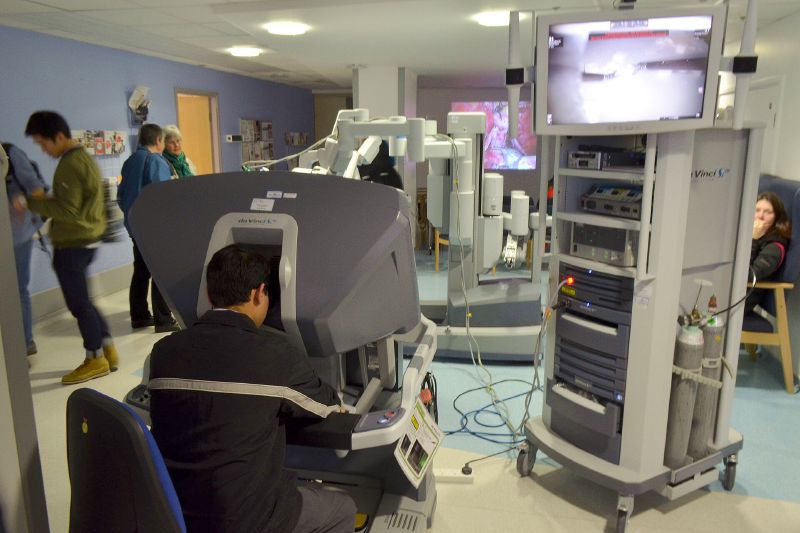
A surgeon decides where the blade goes, even when a robot is holding it. At Scotland’s Golden Jubilee Hospital, consultant thoracic surgeon Alan Kirk removes a patient’s thymus gland from between the lungs. He sits at a console some distance away, moving a pair of hand controls, while three robotic arms carry out each motion beside the operating table. The BBC watched him operate on Stephen O’Reilly, a patient who chose the robotic approach hoping to leave hospital within days rather than a week. The robot never picks a movement on its own. It follows Kirk’s hands from the console.
more
Why a console keeps the surgeon in charge
Kirk operates the £2m da Vinci system installed at the Golden Jubilee. He trained specifically to work this way. Sitting at a console some distance from the patient is a different skill from standing over an operating table, and he describes the adjustment as demanding, physically and mentally. The robot still eases part of the strain, because it removes the need to hunch over a patient for two or three hours at a stretch. What he gains, he says, is vision magnified tenfold and rendered in 3D. His instruments turn through 360 degrees on seven axes, letting him work in ways that even open surgery sometimes cannot match. None of that authority passes to the machine. The da Vinci has held the UK market for fifteen years, and a British-designed rival called Versius has now begun arriving in NHS hospitals. At the Golden Jubilee, a person’s hands set every motion of the da Vinci from the console.
Not every robotic operation runs through a console
Robotic surgery does not always mean a surgeon moving a hand control in real time. For hip and knee replacement, a robotic arm called Mako builds a three-dimensional model of a patient’s own joint before any cut is made, and the surgeon plans the operation on that model first. Orthopaedic surgeon Nick Ohly says this lets the team give every patient a knee replacement matched to their own anatomy, executed exactly as the plan specified once cutting starts. Here, a plan drawn up beforehand does some of the deciding that would otherwise happen in the room.
How much a robot has ever been trusted to decide alone
The industry’s willingness to let a robot act without a hand on it in real time has moved slowly, for a documented reason. Robot-assisted surgery began in 1985, when surgeons at Long Beach Memorial Medical Center took an arm built for factory work and used it to steer a needle into a patient’s brain, taking a biopsy. The operation went well, but the robot’s manufacturer, Westinghouse, halted further use of it, arguing that a machine built for a factory floor lacked the safety features surgery needed. Regulators did not clear a purpose-built surgical robot until 1994, and even then it was a narrow one: a voice-controlled arm called AESOP that only held a laparoscopic camera steady. The da Vinci system, introduced in 2000, gave surgeons fine control of tiny instruments rather than just a camera, and surgeons adopted it cautiously. Fewer than 2% of US operations used a robot in 2012. By 2018 that had risen to about 15%. For prostate removal specifically, more than 90% of US procedures are now done robotically. Those procedures still ran on the model Kirk uses, with a person’s hands supplying the motion.
Where researchers are pushing past that model
At Johns Hopkins University, a robotics lab led by Axel Krieger has spent years testing how much of an operation a robot can carry out once a surgeon stops driving every motion. In 2020, its Smart Tissue Autonomous Robot, known as STAR, performed laparoscopic surgery on a live animal on its own for the first time. It stitched soft tissue back together on its own, but it could not do this unaided. STAR needed specially marked tissue and a plan worked out before the operation began. By 2022, Krieger’s team had moved the same idea onto a live pig, and this time the robot’s software could adjust its plan mid-operation using its own camera feed rather than following a fixed script.
The team’s newest system, called SRT-H, goes further. It runs on an ordinary da Vinci robot rather than custom hardware. Two linked computer models drive it: one plans the steps of a gallbladder removal, and the other turns each step into an exact movement for the robotic arms. Roboticist Ji Woong Kim, who led the work, says the difference from earlier systems is that SRT-H “learns from demonstrations” rather than following a program written in advance. The training data came from a research assistant, who repeatedly performed the operation on tissue from pig cadavers while cameras and sensors recorded every movement, more than 17 hours of it in all. SRT-H then completed the same operation with a 100% success rate on samples it had never seen, matching an expert surgeon’s precision while working somewhat more slowly. It could also take a plain-language correction mid-task, the way a trainee takes a note from a supervisor.
What is keeping a robot like this out of the operating theatre
Nothing SRT-H or STAR has done has happened on a person, and Kim points to a specific reason it stays that way. Training a system like this needs the exact movements a da Vinci robot’s arms made during an operation, not just the camera footage. Intuitive Surgical, the company that makes the da Vinci, will share the video but not the arm-movement data, and Kim says the company’s own engineers want to release it while its legal department will not. Until that changes, robots like SRT-H stay in the lab, tested on pig tissue rather than patients. Every robot actually cutting into a person still answers to a hand on a set of controls. That hand might belong to a thoracic surgeon in Clydebank, or to an orthopaedic surgeon planning a knee replacement before the first cut.