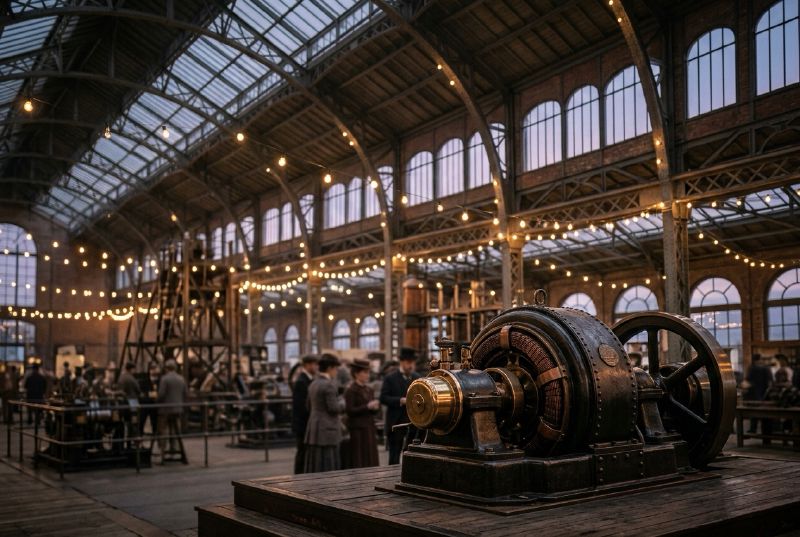
In 1893, General Electric offered to wire the Chicago World’s Fair with Thomas Edison’s direct current for $554,000. George Westinghouse said he could do it for $399,000, using an alternating current system built on Nikola Tesla’s patents. Westinghouse won the contract.
Why direct current came first
Edison developed direct current, the kind that runs continually in one direction, as in a battery. His 1882 Pearl Street station in New York is credited as the world’s first commercial power station. In 1882 Edison lit J. P. Morgan’s Madison Avenue mansion from generators in a nearby cellar, as a test run for a system to feed the whole city. Direct current had one serious flaw. It is not easily converted to higher or lower voltages. Alternating current can also travel much greater distances.
Tesla, a physicist born in Austria-Hungary who emigrated to the US in 1884, argued that alternating current solved the problem. AC reverses direction a set number of times a second, 60 in the US. A transformer can convert it between voltages relatively easily. That meant a power station could send current at high voltage over long distances, then step it down to a safe level once it reached a home or factory.
Edison fought back with fear
Edison had royalties riding on his direct current patents, and he moved to discredit AC as too dangerous for ordinary use. His campaign included public electrocutions of stray animals on AC current, meant to convince the public that alternating current killed. Robert Lifset, a historian of US energy at the University of Oklahoma, says New York City was the first place in the US where commercial electricity was built and sold at scale. He adds that there were “quite a few” controversies that took time to resolve.
The contract that decided it
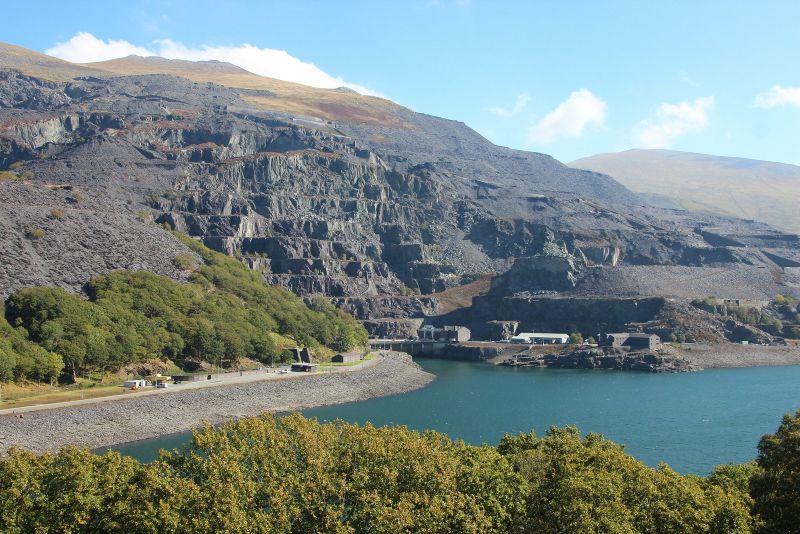
The Chicago fair of 1893 came at the height of the war of the currents. Westinghouse’s cheaper bid used Tesla’s polyphase AC system, and the fair went ahead lit by alternating current. That same year, the Niagara Falls Power Company awarded Westinghouse the contract to generate power from the falls, again built on Tesla’s licensed patents. Some observers doubted a single hydroelectric plant could power a city the size of Buffalo. Tesla believed it could supply Buffalo and the eastern United States besides.
On 16 November 1896, Buffalo’s lights ran on alternating current sent from Niagara Falls. The Energy Information Administration describes the Niagara plant as the world’s first large hydroelectric plant. General Electric, which had bid on the losing side in Chicago, had switched to alternating current by then.
What the win actually settled
Alternating current still powers most of the grid today. It can travel much greater distances than direct current. Westinghouse bought the rights to Tesla’s dynamos, transformers and motors in 1888. Tesla’s patents described a generator, transformer, transmission layout and motor working as a single system, and that basic layout is still recognisable in the grid today. Induction motors built on his design still run household appliances such as washing machines and dryers.
Direct current never disappeared. Computers, LEDs, solar cells and electric vehicles all run on it, and engineers have since found ways to convert it to different voltages that did not exist in Edison’s day. Companies are also finding ways to use high-voltage direct current to move electricity long distances with less loss.
Tesla’s polyphase system earned him worldwide fame but not fortune. Despite winning the argument, Tesla died largely broke and alone in a New York hotel room in 1943. The scientific unit for magnetic flux density, the tesla, was named for him after his death.