On 28 May 585 BC, two armies fighting in Anatolia stopped mid-battle because the sky went dark. The Lydians and the Medes were fighting when the sun vanished. Both sides read it as a sign from the gods and made peace on the spot.
more
The event is remembered as the Eclipse of Thales, because ancient sources credit the Greek philosopher Thales of Miletus with predicting it, down to the year. Modern historians doubt he had the astronomical method to do that with any precision, and BBC Bitesize notes that experts now suspect a lucky guess rather than a calculation. But the story stuck, and so did Thales’s reputation as the man who explained the sky through reason rather than divine anger.
Why an eclipse made a name for reason, not religion
Many cultures gave eclipses a supernatural author. Incan tradition took one as a sign their sun god was angry. Norse tradition described wolves finally catching the sun. Greeks and Romans read eclipses as omens of political disaster. Two armies making peace because the sun disappeared fits that pattern exactly.
Later Greeks counted Thales among the seven sages of ancient Greece. He is often seen as the first to bring deductive reasoning to geometry and astronomy.
The eclipse mattered less than what happened next in Miletus
The Guardian’s review of Carlo Rovelli’s book on Thales’s fellow citizen, Anaximander, argues that the more consequential moment came second. Thales used mathematics to predict eclipses, Rovelli writes. Anaximander, eleven years his junior, took those ideas seriously enough to test them, then improve on them.
That act, Rovelli argues, is what set science apart from inherited wisdom. Knowledge stopped being something handed down by elders or gods and became something built, checked, and revised. Anaximander went on to argue that the movement of air and the heat of the sun caused rain, not divine will. He was also the first thinker on record to argue that the Earth was a body suspended in space, rather than resting on something. The historian of science Karl Popper, quoted in the Guardian’s review, called that idea “one of the boldest, most revolutionary and most portentous ideas” in human thought.
Natural explanations of this kind carried risk. The review notes that 200 years later, such “natural wisdom” was heretical enough to help bring Socrates to trial and death. Rovelli also argues that Chinese stargazers, advanced in many other respects, took another 2,000 years to accept that the Earth hangs in space.
Miletus gave both men room to argue
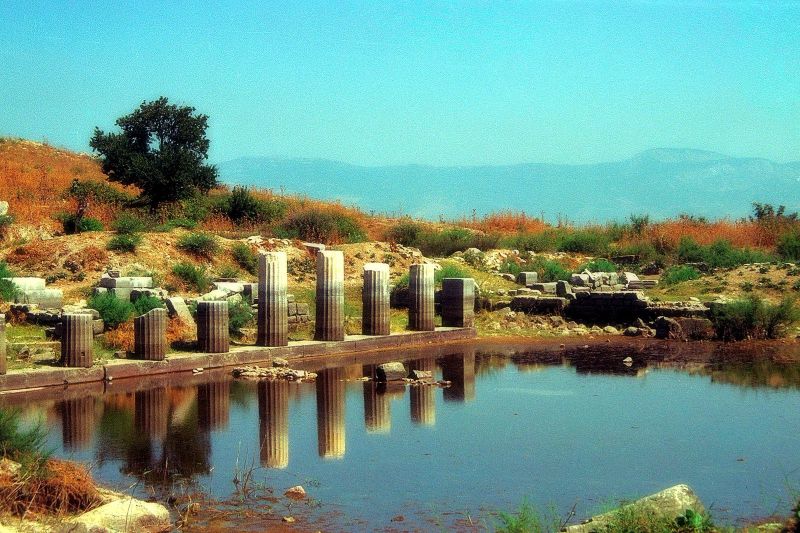
Rovelli’s account, as the Guardian describes it, ties this shift to where it happened rather than just who did it. Miletus, on the coast of what is now Turkey, was a trading city where Greek, Egyptian, and Babylonian knowledge all met, and Anaximander drew on all three traditions. Writing had also spread beyond a narrow class of scribes, and the city’s emerging politics ran on debate rather than decree. Once citizens started treating power as something you could argue about, Rovelli suggests, they started treating knowledge the same way.
Only four lines of Anaximander’s philosophy survive intact. Rovelli pieces the rest together from later writers such as Pliny, Aristotle and Herodotus. The reviewer notes that his claims for Anaximander rest on scattered traces of evidence.
What the eclipse of 585 BC still explains
None of this rests on Thales having actually done the sum. In Rovelli’s account, what mattered was that Anaximander treated Thales’s ideas as something to question and improve. Without a Thales to argue against, there might have been no Anaximander.