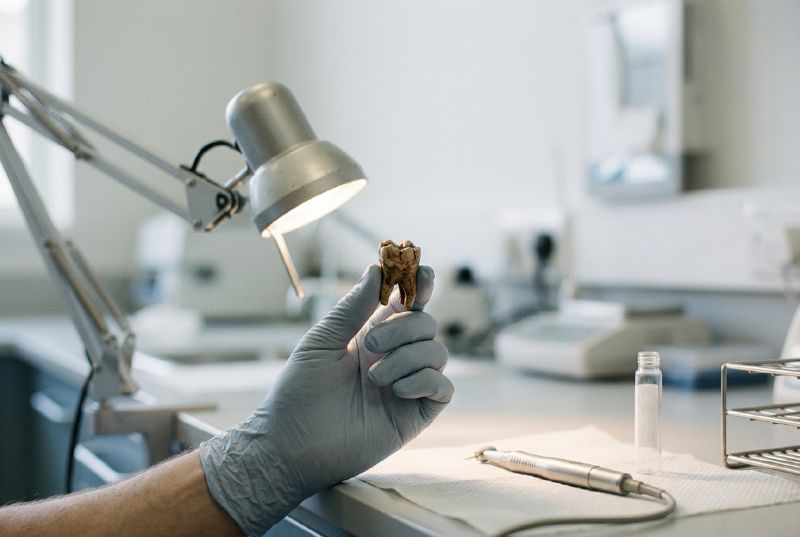
Teeth survive where bone crumbles, because their enamel is 97% mineral. DNA breaks down in sunlight and water, but long after death it survives in teeth and bones. Geneticists extract it in rooms built to keep modern contamination out.
Why teeth outlast almost everything else
The anthropologist Peter Ungar has written that enamel’s mineral content makes teeth stronger than bone, so they are more likely to survive. At an excavation, archaeologists routinely turn up dozens or hundreds of teeth for every skull or skeleton they find.
That toughness matters because DNA itself is fragile. It breaks down when exposed to sunlight and water. It’s also a target for enzymes that destroy it naturally. At the time of that report, the record for recovered human DNA was a Neanderthal fossil 70,000 years old.
The plaque on the tooth
Researchers study more of a tooth than its enamel. They look at the dentine beneath it, and at the hardened plaque, or calculus, on its surface. They have begun extracting bacterial DNA from that calcified plaque. Hardened plaque holds genetic material from the plants and animals a person ate, and from the microbes in their mouth.
In 2017, a team led by University of Adelaide microbiologist Laura Weyrich extracted DNA from the calcified plaque of three Neanderthal individuals found in Belgium and Spain. They published the results in Nature. The plaque held genetic traces of what each Neanderthal had eaten: woolly rhinoceros and wild sheep for the Belgian pair, moss, pine nuts and mushrooms for the individual from El Sidrón, Spain. It also held the DNA of the bacteria living in their mouths. One strain, Methanobrevibacter oralis, yielded a genome roughly 48,000 years old, the oldest bacterial genome sequenced to date.
Keeping the lab’s own DNA out of the sample
Getting a clean read from a tooth this old means solving a second problem. Modern microbes are everywhere. Christina Warinner, an anthropologist who co-directs the Laboratories of Molecular Anthropology and Microbiome Research at the University of Oklahoma, works in rooms kept under positive air pressure and double-sealed. The air is filtered free of any particle larger than 1,000 daltons, roughly the mass of 1,000 hydrogen atoms. Anyone entering removes their shoes and changes into scrubs. In the innermost rooms, they add a Tyvek suit, surgical mask, hairnet and face shield before going near a sample. Warinner says ancient DNA work usually happens in “dungeon-like labs located in windowless basements”. Her lab, by contrast, has picture windows onto a university atrium.
The idea of reading plaque goes back decades, but the tools are recent. Museums and labs used to clean calcified plaque off new specimens as a matter of routine. Researchers at the time cared about the wear patterns on the teeth themselves, not what was stuck to them. Only in the past ten to fifteen years, once high-powered microscopy and precision genetic sequencing made the plaque itself worth reading, did labs start preserving it rather than scrubbing it away.
What the extracted DNA can and can’t tell you
Genetic material from plaque can reconstruct elements of diet. In cases like the El Sidrón Neanderthal, it can point to a specific health problem. That individual carried Methanobrevibacter oralis, a bacterium linked to gum disease, alongside a probable dental abscess. Residue from poplar, a plant source of salicylic acid, the compound in aspirin, turned up in the same sample. So did genetic material from Penicillium rubens, a mould that produces antibiotics, suggesting possible self-medication.
Forensic scientists identifying tsunami victims treat time as the lesser obstacle. Mark Thomas, a forensic anthropologist at University College London, has said that taking a reliable DNA sample from a body is “straightforward” when a biopsy can be stored in a chemical buffer or frozen. The harder problems are administrative: tracking where samples came from and who has access to them. For ancient samples, contamination is the bigger worry, because the modern world is swimming with microbes like the ancient ones under study.
A tooth can carry a record of its owner’s diet and health in its dentine and plaque. Reading that record means keeping modern contamination out of the lab.