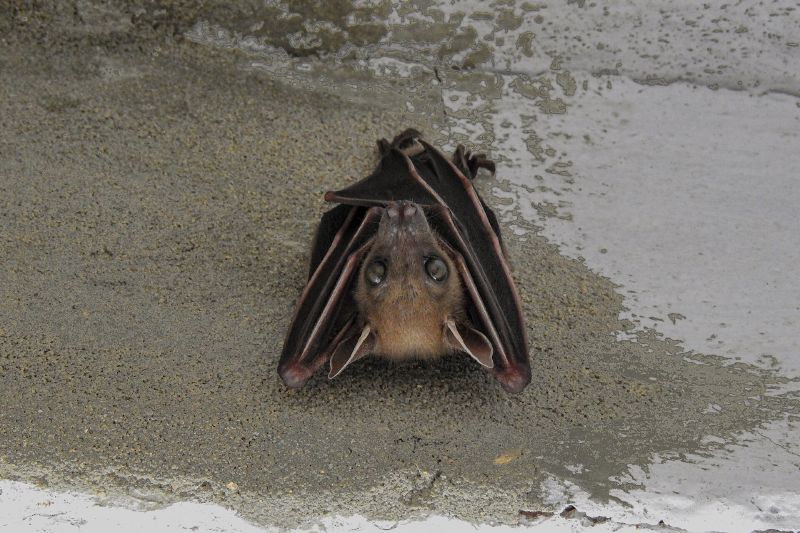
A bat leaving a crowded cave does two things. It moves out from the dense middle of the swarm, and it changes the way it calls. Within five seconds of leaving the roost, it switches to shorter, weaker calls at a higher pitch. Those calls tell it most about the one bat directly ahead, and that is the bat it could hit.
more
The answer comes from field work. Researchers at the Max Planck Institute of Animal Behavior and Tel Aviv University published it in the Proceedings of the National Academy of Sciences.
Why a cave exit should be chaos
Many bats see with sound. A bat sends out a call and listens for the echo that comes back. When a whole colony leaves in a few minutes, every bat is calling at once. The other bats’ calls should drown out the echoes each one needs.
Scientists call this jamming. They also call the scene a “cocktail party nightmare”, after the struggle to hear one voice in a noisy room. On paper, jammed bats should collide.
They almost never do. Aya Goldshtein of the Max Planck Institute says crashes outside caves are so rare that “you’re almost excited when you witness one”. She has watched colonies of hundreds of thousands pour out of a single small opening.
Following bats into the swarm
Earlier work had looked at small groups in the laboratory. There, each bat called at a slightly different frequency, which in theory cuts jamming. Yossi Yovel of Tel Aviv University said nobody had yet studied a single bat during a real emergence.
So the team went to the Hula Valley in Israel and tagged greater mouse-tailed bats. Over two years they fitted tens of bats with light trackers that logged position every second. Some tags also carried ultrasonic microphones, which recorded what each bat heard.
The tags had a gap. The team released tagged bats into the colony outside the cave, so there was no real data at the mouth, where crowding peaks. Omer Mazar built a computer model to fill it. The model ran each bat from the cave entrance to 2 kilometres out across the valley.
The two changes that clear the air
The numbers at the exit are stark. As bats left the cave, 94% of their calls were jammed. Five seconds later, jamming had dropped sharply.
The first change is space. Bats fanned out from the packed core of the colony but kept the group together.
The second change looked odd at first. The bats made shorter, weaker calls at a higher frequency. More calling might seem to make jamming worse. Mazar’s answer was to think like the bat. The object that matters most is the bat straight ahead, so a bat should call in the way that tells it the most about that one animal.
Bats also follow a leader
A 2015 study of a different species found another layer. Marc Holderied of the University of Bristol tracked wild Daubenton’s bats hunting over water in the UK. His team logged 70,000 data points on the bats’ flight.
They found that the bats used echolocation to track other bats as well as prey. Pairs dodged each other by one speeding up while the other slowed down. A bat would also pick a leader and copy its turns and dives. Its reaction time was about 500 milliseconds, roughly the length of a blink, so the two moved almost in step.
The leader was not always in front. Echolocation gives a bat a full 360-degree picture, so a bat could lead from behind. Some pairs swapped the lead several times in one flight.
Holderied called a whole cave of bats in flight at once “the holy grail of swarm robotics”. The Tel Aviv and Max Planck team has now given the first account of how one of those swarms stays out of its own way.