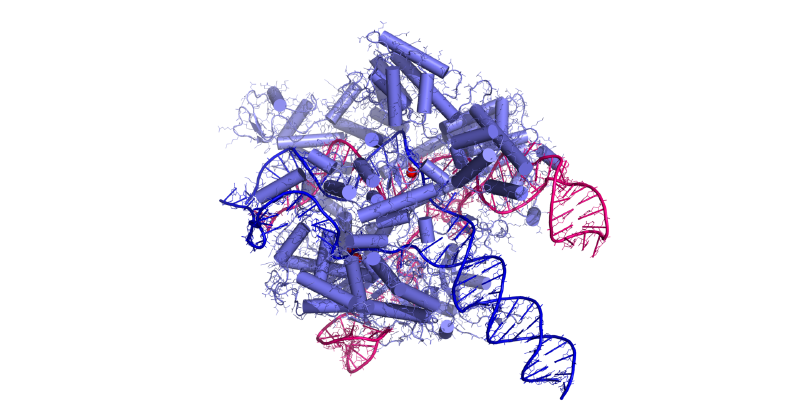
Cas9 is a protein that cuts DNA, and a short strand of RNA tells it where to cut. Change the RNA and the same protein cuts a different gene.
more
The RNA supplies the aim.
Where did Cas9 come from?
Bacteria. Around the turn of the century, microbiologists at Danisco USA found that some of the bacteria in their yogurt and cheese vats could fend off viruses. Those bacteria carried odd, repeating stretches of DNA that held pieces of past invaders.
The pieces work like a memory. When a bacterium survives an attack, it adds a snippet of the virus’s DNA to its own genome. If the virus returns, the bacterium makes RNA strands that match that snippet and home in on the same sequence in the virus.
The RNA carries Cas9 to the target. The protein then cuts the virus’s DNA at that spot and disarms it. About half of known bacteria have a system like this, and so do most archaea.
How does it find one gene among billions of letters?
By matching. The strep throat bacterium makes two RNA sequences that attach to Cas9, a protein WIRED describes as clam-shaped. The RNA steers the enzyme to a strand of DNA that complements it. Once there, Cas9 changes shape, grabs the DNA and slices it in two.
Jennifer Doudna and Emmanuelle Charpentier worked this out and showed the cutting on circular DNA in test tubes. They published in Science in 2012. They also built a single custom molecule, a guide RNA, that can be written to mirror any DNA strand.
The consequence is that you change the guide and leave the protein alone. WIRED puts it this way: swap the RNA guide and you can send Cas9 anywhere, such as the gene behind Huntington’s disease. About six months later, Feng Zhang of the Broad Institute published a paper in Science showing that the system could edit human cells as well.
What happens after the cut?
The cell repairs it. Often the repair is imperfect, and the result is a broken gene. For some uses that is all a scientist needs.
The first approved CRISPR treatment works this way. The US Food and Drug Administration approved it in December 2023 for sickle cell disease, and in January 2024 for beta thalassemia. It breaks a gene called BCL11A, which normally keeps a fetal form of haemoglobin switched off. With BCL11A broken, adult blood cells make that fetal haemoglobin again.
A cut can also set up a precise rewrite. The Scientist describes a version for the HBB gene, where Cas9 and a donor strand of corrected DNA replace a disease-causing variant. The cell’s own repair machinery does the mending in both cases.
Why a cut is not always clean
Cas9 sometimes cuts in the wrong place. Researchers call these off-target edits. At EMBL, Lars Steinmetz’s group edits one cell of a two-cell mouse embryo and compares the offspring cell populations with those from the untouched cell. The comparison separates natural background mutations from damage the editing caused. Counting the off-target changes shows how accurate each editing method is.
Getting the machinery into the right cells is a second problem. Therapies either edit cells in the body or take cells out, edit them in a laboratory and return them.
What is left to find?
Cas9 is one of several cutting enzymes. Microbes also make others, such as Cas12. In June 2023 a team led by Feng Zhang reported in Nature a CRISPR-like cutter called Fanzor, found in fungi, algae, amoebae and a clam called the northern quahog. Whether Fanzors can do for biotechnology what Cas9 has done is an open question.