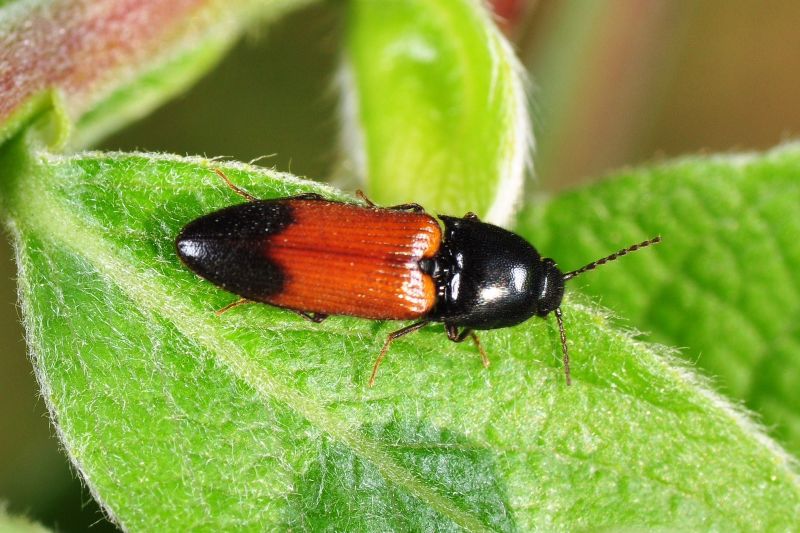
A click beetle on its back does not push with its legs. It throws itself into the air with a hinge between two segments of its body. The beetle bends the hinge and holds it under strain, then lets it go. The stored energy snaps free with a loud click and launches the insect upward.
more
The jump can carry a beetle more than 20 body lengths high. No leg touches the ground to do it.
Where the hinge sits
The hinge is in the thorax, just behind the head. Researchers at the University of Illinois Urbana-Champaign describe it as a feature no other insect uses to jump.
It works like a catch. Marianne Alleyne, an entomology professor on the Illinois team, described a peg on one side that hooks onto a lip on the other. While the peg stays hooked, the beetle can build up tension. When the latch lets go, the click sounds and the body unbends in a flash.
Gal Ribak of Tel Aviv University told National Geographic that the beetle contracts the hinge when it is threatened. So the same trick serves two ends. It rights a beetle stuck on its back, and it gets the beetle away from danger.
Loading the spring
For a long time, scientists had filmed the jump but not the machinery inside it. An ordinary camera shows what happens outside the beetle. It cannot show how energy moves between muscle, soft tissue and the hard outer shell.
The Illinois team used high-speed X-ray video to see inside. John Socha of Virginia Tech and Kamel Fezzaa of Argonne National Laboratory helped collect the footage. The team published its results in 2021 in the Proceedings of the National Academy of Sciences. The US Department of Energy funded the study. To break the click into its phases, the team used a method called system identification on the X-ray footage.
The X-rays showed a slow build-up. Before the jump, soft tissue in the hinge bends a long way, and it bends gradually. That tissue is where the beetle stores the energy.
The snap
Then the peg slips over the lip. Aimy Wissa, a mechanical engineering professor who co-led the work, said the soft tissue releases its strain very fast at that moment. The peg then rocks back and forth in the cavity below the lip before it settles.
Wissa named two engineering ideas at work. The fast release is elastic recoil. The shrinking wobble afterwards is damping, which soaks up the leftover energy.
Ophelia Bolmin, the study’s lead author, said the insect relies on snap-buckling to let the energy out so fast. She compared it to the jumping popper toys.
How hard the launch hits
The numbers differ by source. The Illinois team measured an acceleration of more than 300 times Earth’s gravity. National Geographic, citing Ribak, put the launch at 380 times the force of gravity. Either figure dwarfs what a fighter pilot can take.
The beetle survives this again and again. Alison Dunn, who co-led the Illinois study, said it can repeat the click without significant physical damage. That durability is what sent the team looking at how the beetle stores, releases and absorbs the energy.
The landing is luck
The flip is not precise. In a 2011 study, Ribak found that a click beetle has little control over where it comes down.
There are about 900 species of click beetle, and all of them share the hinge trick for righting themselves. Wissa said an engineer designing a jumping device would probably build it the way the beetle does. The Illinois researchers say the findings could guide work on other small, fast animals, such as trap-jaw ants and mantis shrimps.