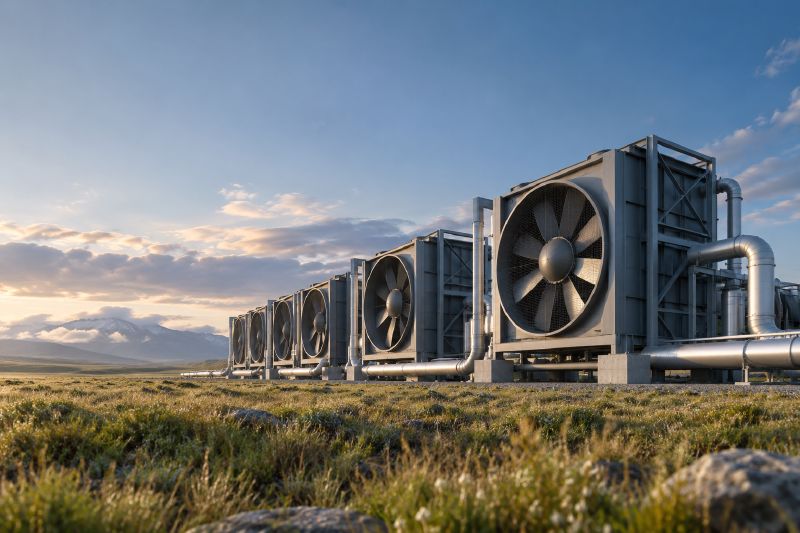
A direct air capture plant pulls carbon dioxide out of the sky in two steps. Large fans draw air through a filter holding a material called a sorbent, which grabs the CO₂. Then the plant heats the sorbent, or treats it another way, so it lets the gas go again. The US National Institute of Standards and Technology (NIST) describes that as the typical design.
The released carbon can then be buried deep underground or put to industrial use, such as making concrete or synthetic fuels.
Why is the air harder than a chimney?
Capturing CO₂ at a smokestack is a different job. In open air the gas sits at a very low concentration, which IEEE Spectrum notes makes removal far more complex and costly. The fans have to move a great deal of air to collect a little carbon.
Solid sorbents and liquid ones
Sorbents come in two kinds. NIST lists ion exchange resin, polymer-impregnated mesoporous silica and metal-organic frameworks among the solid ones.
Canadian firm Carbon Engineering uses a liquid. At its pilot plant in Squamish, British Columbia, a fan pushes air into a liquid mixture that binds the carbon dioxide, the BBC reported. The company then turns the captured carbon into pellets of calcium carbonate. Heated to about 900C, those pellets break down into calcium oxide and a stream of CO₂, which is cleaned of water. The BBC reported that the pilot had run since 2015, removing around a tonne of CO₂ a day.
Plants are still small
Small, so far. The first US plant, in Northern California, can remove at most 1,000 metric tons of CO₂ a year, which NIST compares to taking roughly 200 cars off the road. More than 100 such facilities are in some stage of development worldwide.
Larger designs exist on paper. Storegga and Carbon Engineering planned a plant in north east Scotland to remove up to a million tonnes a year, which the BBC put at the uptake of about 40 million trees. The International Energy Agency expects DAC plants to remove nearly a billion metric tons a year combined by 2050, NIST reports.
Pamela Chu, who coordinates NIST’s carbon accounting programme, said the technology needs to grow by about six orders of magnitude to matter for the climate.
Measuring the sponge
That growth needs a fair way to compare sorbents. NIST built a test rig about the size of a home printer. It blows synthetic air through a thin column of sorbent and measures how much CO₂ slips past as the material fills up. The result, a breakthrough curve, shows how fast a sorbent saturates.
Gaurav Sant of UCLA’s Institute for Carbon Management raised a further test. He told IEEE Spectrum that a useful method should turn the gas into something stable, not just bury it where it could leak.