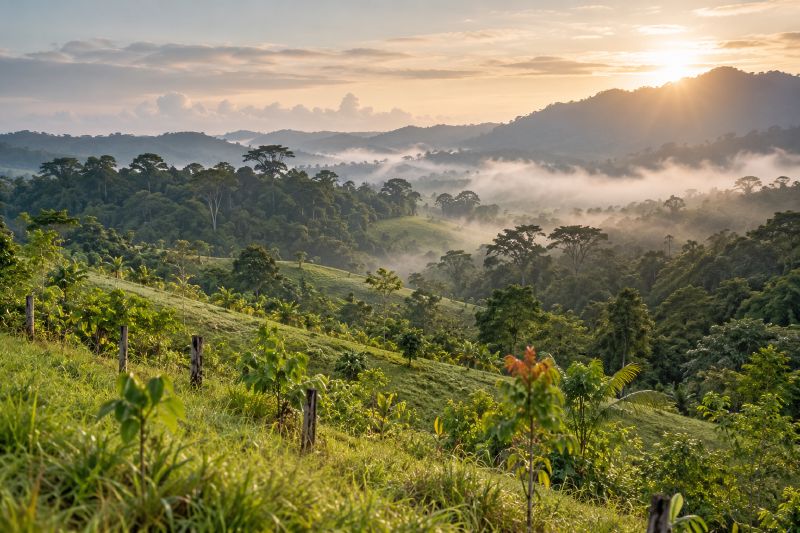
In 2021, Ecuador’s Constitutional Court blocked a mining company from digging in the Los Cedros cloud forest, ruling that the mine would damage the forest’s biodiversity and so violate the forest’s own constitutional rights. Nobody had to show that a person was harmed. Since 2008, Ecuador’s constitution has given nature itself the right to exist and to keep its own cycles going. It lets any person or community demand those rights before public bodies.
José DeCoux lived in the Los Cedros forest for more than 30 years, after moving there from the US in the 1980s. When a mining company began exploring the forest for gold and copper in 2019, he sued to stop it under the constitution’s rights of nature clause. A lower court threw the case out, and it only reached the Constitutional Court because the court chose to take it up as a test of what the new right actually meant in practice. Two years later, DeCoux won.
more
What the constitution actually created
Ecuador approved the new constitution in September 2008. Grist reported at the time that it was the first constitution anywhere to grant nature an inalienable right to exist. The text gives nature “the right to exist, persist, and regenerate” its own cycles, structures and functions. The reference to evolution in that clause is not an accident. Ecuador’s Galapagos Islands are where Charles Darwin worked out the theory in the first place, Grist noted at the time.
The BBC describes the change as one of the first major steps in the rights of nature movement. Ecuador’s Indigenous movement led it. Jacqueline Gallant, of New York University’s Earth Rights Advocacy Clinic, describes the wider movement as an attempt “to transform natural entities from objects to subjects” in the eyes of the law.
How courts have used it since
Ecuador’s constitution never defines what its rights mean in a specific dispute, so that work has fallen to judges, case by case. Gallant compares it to the right to free speech in the US constitution. The document states the right in general terms, and centuries of case law then worked out what it means in practice. Ecuador’s courts are doing the same thing, only over sixteen years rather than two centuries.
One of the clearest examples involves a frog. The longnose harlequin frog was thought extinct until its rediscovery in 2016. That reappearance gave activists an opening to make it a plaintiff, alongside other endangered species, in a case against Ecuador’s environment ministry and two mining companies operating in the Intag Valley. The frogs won. Ecuador’s Constitutional Court ruled that a copper mining project violated their right “to have their existence fully respected,” and it revoked the companies’ environmental licence over what the court called serious methodological flaws. The ruling did something broader than protect one species: it flipped the burden of proof. A mining company or government agency now has to show its work will not cause harm, rather than forcing objectors to prove that it will.
The Los Cedros ruling went further still. Ecuador’s Constitutional Court framed the danger there as one to whole species and ecosystems, not only to people. Months later, the same court ruled that wild animals hold rights of their own: to exist, to develop their natural instincts, and to be free from disproportionate cruelty, fear and distress.
Why the country still isn’t finished with mining
By 2024, Inside Climate News counted more than 70 Ecuadorian court cases built on the rights of nature, more than any other country with a similar law on its books. Roughly 30 countries recognise some form of nature’s rights, the same report found, while the BBC puts the number of countries pursuing some kind of rights of nature initiative at 44. Either figure makes Ecuador the outlier, not only because it had the idea first, but because its courts keep acting on it.
That legal record sits inside an economy that still runs on the industries its own courts keep stopping. Ecuador’s president, Daniel Noboa, has pushed to attract mining investment into a country rich in copper, gold and silica sand, even as individual projects keep losing in court. Voters have pushed back directly too: in 2023, two national referendums blocked mining in the Chocó Andino cloud forest and halted oil production in part of the Amazon rainforest.
Natalia Greene, one of the activists behind Ecuador’s rights of nature cases, says a whole generation of young Ecuadorians has grown up knowing nothing else. To them, nature having rights is simply how the law works. Whether that holds is still being settled the way it always has been in Ecuador: one lawsuit, one forest, one river at a time.