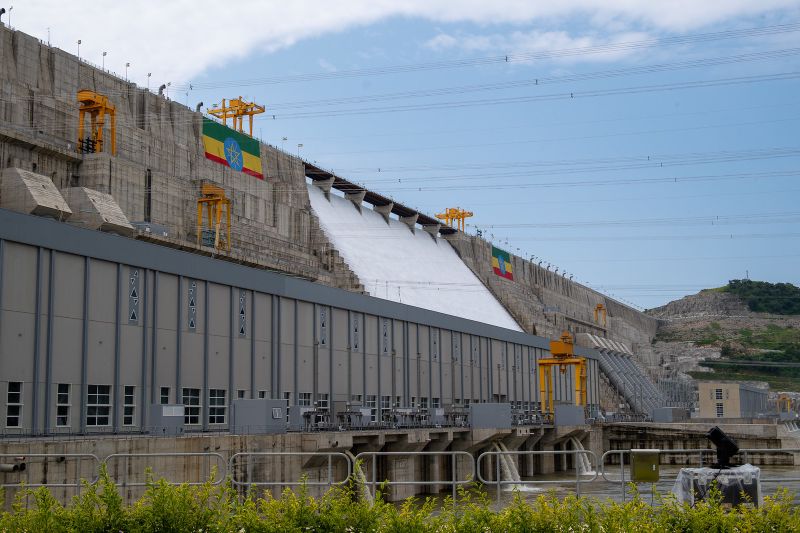
Ethiopia finished building the Grand Ethiopian Renaissance Dam in July 2025 and launched it officially on 9 September 2025. Egypt, Sudan and Ethiopia still have no binding agreement on how it is filled and run. Egypt says the dam threatens the river it depends on. Ethiopia says it needs the power, and that treaties it never signed cannot stop it.
more
What Ethiopia built
The dam stands on the Blue Nile in the northern Ethiopian highlands, about 30km from the Sudanese border. The BBC describes it as more than a mile long and 145m high, with a reservoir whose surface is roughly the size of Greater London. Construction began in April 2011, and the build cost more than US$4 billion, raised mostly from Ethiopians at home and abroad.
The purpose is electricity. John Mukum Mbaku, writing in The Conversation, puts the expected output above 6,000 megawatts, enough to make Ethiopia the continent’s largest power exporter. The BBC reports that Ethiopia wants the dam to reach the 60% of its people who have no supply, and hopes it will eventually double national output. Neighbours including Sudan, Kenya and Djibouti could buy the surplus.
The first turbine began sending 375 MW to the grid on 20 February 2022.
Why Egypt objects
Egypt gets more than 90% of its fresh water from the Nile. The BBC counts about 107 million people there, and notes that the river also fills Lake Nasser behind Egypt’s own Aswan High Dam. Egypt has argued that losing 2% of the Nile’s flow could cost it 200,000 acres of irrigated land.
Its sharpest worry is drought. Mohammed Basheer of the University of Toronto told the BBC that nothing agreed says how the dam should run during and after a dry spell. Without that, he said, Ethiopia might refill its reservoir first to recover generating power, which would hurt Egypt.
Where Sudan stands
Sudan, with about 48 million people, leans on the Nile almost as heavily as Egypt. Its main concern, according to Mbaku, is how the dam affects the running of Sudan’s own dams. A civil war since 2023 has limited how hard Khartoum can press that case.
The treaties underneath
Two colonial-era agreements sit under the whole argument. The 1929 Anglo-Egyptian Treaty and the 1959 treaty between Egypt and Sudan allotted the river’s water between those two countries and gave Egypt a veto over building on the Nile and its tributaries. Under the 1959 deal, Egypt took 66% of an average yearly flow of 84 billion cubic metres, and Sudan 22%.
Ethiopia signed neither. Its highlands supply more than 86% of the water that reaches the Nile, according to Mbaku, and the upstream states have long argued they are not bound by treaties they were not party to. Ethiopia chose to start construction during the Arab Spring, while Egypt was in political turmoil.
How the filling fight played out
Once the dam was going up, Egypt and Sudan turned to how fast it would fill. They proposed a filling period of 12 to 21 years to protect their supply, and Ethiopia wanted a much shorter one. Ethiopia went ahead, filling the reservoir in five stages between July 2020 and October 2024.
Talks have run alongside all of it. The three countries signed a Declaration of Principles in 2015, but negotiations over the filling kept breaking down. The International Crisis Group warned in 2019 that armed conflict was possible, and a US effort to broker a deal that year achieved little. The African Union and the United States have both intervened, and Egypt has appealed to the UN Security Council, with no deal.
Why the deal keeps slipping
Egypt insists that any talks on sharing water start from its rights under the 1959 treaty. Ethiopia and the other upstream states reject that starting point, so the two sides disagree before they reach the numbers.
Emanuele Fantini of the IHE Delft Institute for Water Education offers another reason. He writes that technical negotiators had nearly agreed how to fill the dam and operate it in drought, but political leaders rejected the result. In his account, the river carries too much national meaning in each country for a leader to be seen giving ground.
With the reservoir full, the fight over filling is over. The fight over who controls the flow in the next drought is not.