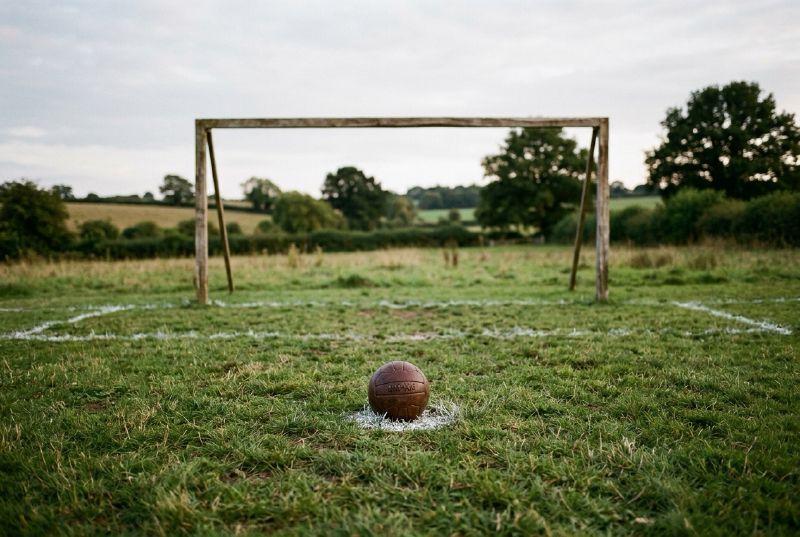
A Notts County defender handled the ball on his own goal line during an FA Cup quarter-final against Stoke City in 1891, stopping a certain goal. A similar incident in Scotland added to the pressure. In June 1891, football’s four British associations wrote a new punishment into the game’s laws: a shot from 12 yards, defended by nobody but the goalkeeper. Football has called it the penalty kick ever since.
The new law closed a gap that had sat in the game since the Football Association wrote its first rules in 1863. Back then, a deliberate foul on the goal line brought only a free kick, taken from wherever the offence happened, and a defending side could crowd the goalmouth to block it. The men who drafted that law assumed that gentlemen would not cheat. For decades the assumption largely held, because the game still belonged mostly to public schoolboys who saw a deliberate foul as beneath them.
Who wanted to fix it, and why
By the late 1880s football had spread into the industrial towns of northern England, into Scotland and across the Irish Sea, and wages, leagues and points had arrived with it. William McCrum kept goal for Milford Everton in his home village in County Armagh, and had no time for foul play around the goal. He was the son of a wealthy linen manufacturer who preferred sport to the family business. His club lost every match of the inaugural Irish Football League in 1890 to 1891, and McCrum conceded 62 goals in 14 games, which gave him ample opportunity to watch a deliberate foul pay off.
In 1890 McCrum drafted a proposal: any deliberate foul by the defending side within 12 yards of its own goal would bring a direct kick at goal, defended by nobody but the goalkeeper. He sent it to the Irish Football Association, which passed it to the International Football Association Board, the body that still writes football’s laws. His proposal was met with scorn, according to Joe McManus, a historian in Milford, who thinks McCrum’s fondness for amateur theatre may have shaped his thinking: a penalty, McManus said, is “a supreme moment of drama.”
Why the board called it an insult
The English football establishment reacted with something close to fury. Opponents branded the proposal “the Irishman’s notion” and would not accept that a player might foul on purpose, according to McManus. The FA called it an insult to assume that “players intend to behave like cads.” The Corinthians, an amateur club whose players turned out for England, called the rule “the death of the gentleman’s game,” and their own player C.B. Fry described it as “a standing insult to sportsmen.” English newspapers went further still, branding the penalty the “kick of death.”
What changed the board’s mind
Between 1890 and 1891, the goalmouth fouls McCrum had complained about kept happening, and the board’s opposition began to soften. Then came the Notts County handball against Stoke City and the matching incident in Scotland, proof that a mere free kick was not enough to stop a professional foul. The four associations met that June and settled the shape of the new law: a penalty taken from anywhere along a mark 12 yards out from goal, every outfield player at least 6 yards from the ball, and the goalkeeper free to advance up to 6 yards off his own line. The rule took effect for the 1891 to 1892 season.
How the rule survived its first weeks
Wolverhampton Wanderers’ John Heath scored English football’s first penalty, against Accrington at Molineux on 14 September 1891, and Wolves won 5-0. Five days later his teammate Harry Allen became the first player to miss a league penalty, shooting over the bar against West Bromwich Albion. Around the same time, Harry Bailey of Leicester Fosse scored what was in all likelihood the second penalty in English football, in a friendly against the very club whose handball had started it all: Notts County.
The Corinthians never accepted the rule on its own terms. When a penalty went against them, their goalkeeper stepped aside and let the ball pass rather than dignify the accusation of cheating with a save, and when they won a penalty themselves, they deliberately missed it. The gesture mostly cost them matches.
How the law kept moving after 1891
The penalty kept changing shape for decades. When Stoke City were denied a last-minute penalty in November 1891 because an Aston Villa player kicked the ball out of the ground and ran down the clock, the board added a rule letting a penalty be completed after full time. The penalty spot itself did not exist until 1902, when the rectangular penalty area replaced the old line running the width of the pitch. Goalkeepers kept the right to advance 6 yards until around 1905, when so many penalties were being saved that lawmakers confined them to the goal line, and the arc marking how far other players must stand did not arrive until the 1937 to 1938 season. The lawmakers are still refining it: in 2025 IFAB clarified that a kicker who accidentally touches the ball twice before anyone else does earns a retake rather than a foul.
McCrum did not live to see how far his idea travelled. He lost his wife, ruined his family and died a pauper in 1932, having gambled away what remained of the linen fortune at the bookmakers. In 2010 Milford put up a monument on the pitch where he once played, and Gary Lineker, filming a BBC documentary at his grave in Armagh, told the cameras, “This man has a lot to answer for.” A campaign by the village’s own supporters’ club later persuaded FIFA to pay for the grave’s repair.
About a third of penalty kicks fail, writes his great-grandson Robert McCrum, the author of a book called The Penalty Kick.