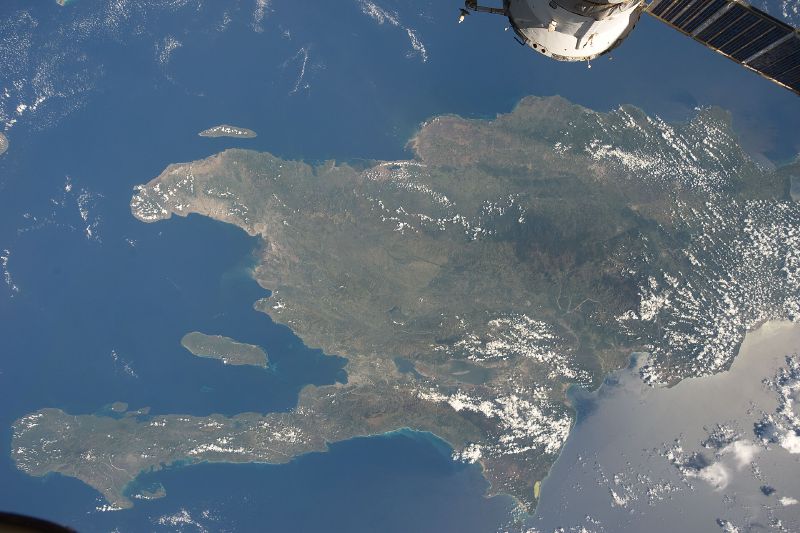
Haiti grew from the western third of Hispaniola, which Spain ceded to France in 1697. The Dominican Republic, on the rest of the island, did not break away from Spain at all. It broke away from Haiti, in 1844.
more
How Spain and France came to share one island
Christopher Columbus landed on Hispaniola in 1492 and gave the island its name. Four years later Spain founded Santo Domingo, the first European settlement anywhere in the Western Hemisphere, on the site that is now the Dominican Republic’s capital.
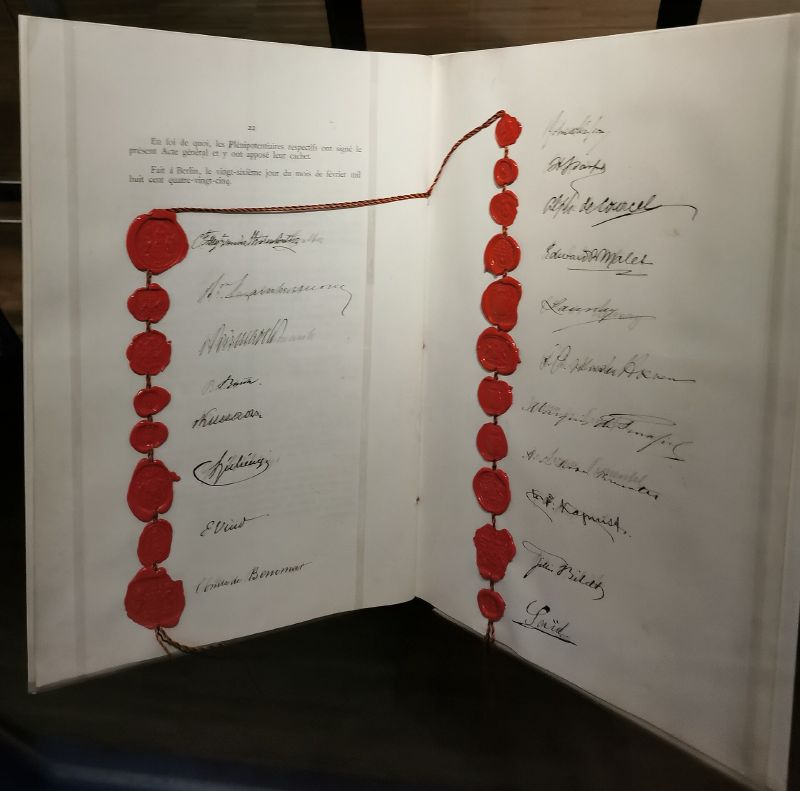
In 1697, Spain ceded the western part of Hispaniola to France. The Guardian’s account of the island’s history dates a further cession later still. Spain had ceded the entire island to France by 1795.
One island, briefly, under one government
In 1801, Toussaint Louverture, a general who had been enslaved, freed Hispaniola’s slaves and proclaimed himself governor-general over the whole island, uniting both the French and Spanish sides under one government. Napoleon answered by sending an army under his brother-in-law, Charles Leclerc, in 1802, but Leclerc’s force failed to subdue the Haitian interior. Haiti declared independence in 1804, and Jean-Jacques Dessalines, also formerly enslaved, proclaimed himself emperor.
Independence in the west did not settle the east. Dominicans launched what the Guardian calls a war of reconquest in 1808, driving out French administration and returning the eastern part of the island to Spanish rule. That arrangement did not hold either. By 1822, Haiti had retaken control of the entire island once more.
Why did the Dominican Republic break from Haiti rather than Spain?
Haitian rule over the east lasted 22 years, and it ended badly. In a dispatch to the Foreign Office dated July 15, 1843, Thomas N. Ussher, the British consul at Port-au-Prince, described the Spanish-speaking east as unsettled and reported that its people were ready to “return to the domination of their former masters”, or of any other European power. Within a year, Santo Domingo rose against the Haitians occupying the island, and the Dominican Republic declared its independence in 1844.
Independence did not bring self-rule. According to History Today, the new republic’s own political leaders spent the years afterwards trying to hand the country to a European power rather than govern it themselves. They courted France first, then Spain, which briefly re-annexed the Dominican Republic in 1861. The country’s founding act was a break from Haiti, not from Spain.
The border hardened rather than faded
The line has carried more than a boundary between governments. In 1937, the Dominican dictator Rafael Trujillo ordered the massacre of Haitians living in the border region, many of them workers in the sugar cane fields. Soldiers used a test to sort victims, asking dark-skinned people to say “perejil”, the Spanish word for parsley, and killing those whose Haitian Creole made the trilled “r” hard to produce. Estimates of the dead range from 10,000 to 25,000 killed over a few weeks, a detail sharpened by the fact that Trujillo’s own grandmother was Haitian.
The legal border has kept shifting even where the physical one has not. In 2013, the Dominican Republic’s highest court revoked the citizenship of children born in the country to undocumented Haitian migrants, and applied the ruling retroactively to anyone born after 1929. Dominican-born people of Haitian descent numbered around 210,000, in a country of ten million. Some 40,000 people had already been told they would not receive identity documents. Deportations were already common. The Dominican military reported sending away about 47,700 Haitians in the preceding year, more than double the 21,000 it had deported the year before that.
The split that began with Spain’s cession in 1697 still runs through the island. What keeps moving is who gets to stand on which side of it, and on whose papers.