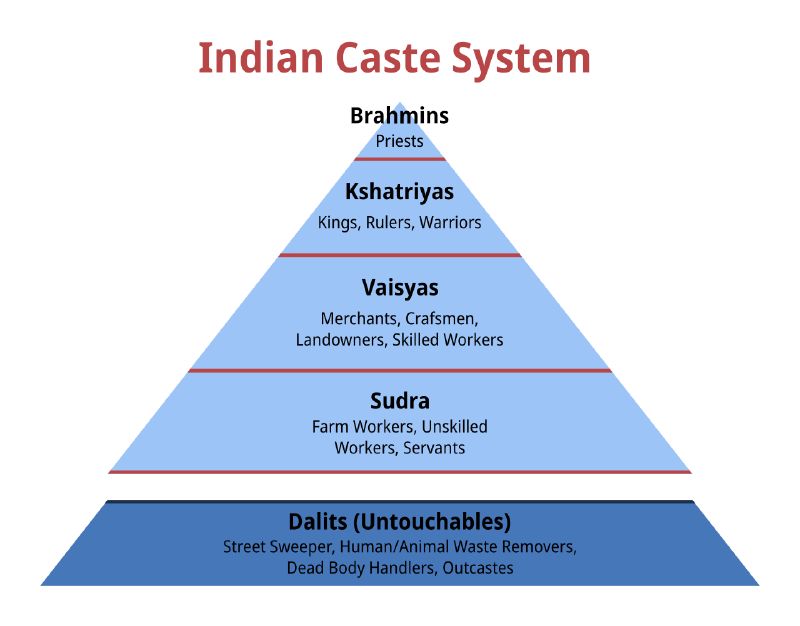
In 2019, only one of the 89 most senior civil servants in India’s federal government was a Dalit, from a group once called “untouchable,” according to parliamentary data. That single gap points at something larger. Caste still decides who gets a job in India. It also decides who a family lets a child marry.
more
How a surname decides who gets the job
India’s civil service exam is the country’s toughest competitive test. Roughly a million people sit it each year, chasing about a thousand posts across the Indian Administrative Service, the Indian Foreign Service, and the police. Of those, close to 180 succeed, a pass rate near 0.01%.
Candidates’ names and religion stay hidden while examiners mark the written papers. Once a candidate reaches the interview stage, the recruiting body, the Union Public Service Commission, uses their full name again. That switch matters because about 90% of Indian surnames give away a person’s caste. The Dalit Indian Chamber of Commerce and Industry’s research wing studied the process for India’s Ministry of Social Justice and Empowerment. Its report urged the government to hide every candidate’s surname through the whole process.
“Objectivity goes out of the window” once an interviewer spots a caste in a surname, said PSN Murti, the researcher behind the report. He said India is not a society that takes people on merit, and is ridden with discrimination. Swaran Ram Darapuri, a retired senior police officer in Lucknow, said the effect on Dalit candidates goes further than the interview room. Many grow up without English spoken at home, he said, and arrive without the fluency and confidence more privileged candidates take for granted. Interviewers who catch the caste in a name, he added, “are going to be prejudiced against them.”
Quotas exist to close that gap. The commission reserves 15% of civil service places for Dalits, on top of separate quotas for other disadvantaged groups. Yet only one of the 89 secretaries, the most senior rank in Delhi’s federal bureaucracy, was a Dalit in 2019, even though roughly 200 million Dalits make up about 16% of India’s population.
The same sorting shows up further down the ladder. Prison jobs in the northern state of Rajasthan, among them barber, sweeper, cook, and gardener, were being handed out by caste. Maharashtra, the state that includes Mumbai, went the other way and renamed neighbourhoods that had carried the caste name of their largest community, calling the old naming a “regressive” custom.
Why marriage rarely crosses the line
Hiring is not the only place the hierarchy holds. Most Indian families still want a son or daughter’s marriage arranged inside their own religion and caste, and a couple who steps outside that boundary can face violence, including so-called honour killings.
Only about 5% of marriages in India cross a caste line, according to the India Human Development Survey. Ravindra Parmar, a trained engineer from a Dalit family in Gujarat, learned what that 5% can cost. He fell for Shilpaba Upendrasinh Vala, who comes from a Rajput family near the top of the hierarchy. The couple has since moved house a dozen times over three years to stay safe. Ravindra had to leave his engineering job and has done daily-wage work wherever they have lived.
The fear behind that flight is measurable, if undercounted. India’s National Crime Records Bureau logged 77 murders with “honour killing” recorded as the motive in 2016, and the BBC notes that such violence is highly under-reported. A separate study that year, Social Attitudes Research for India, surveyed people across Delhi, Mumbai, Uttar Pradesh, and Rajasthan and found most opposed inter-caste and inter-religious marriage outright, with many favouring a law against it.
Amit Thorat, a professor at Jawaharlal Nehru University who worked on that survey, said rising literacy has not softened the attitudes it measured. Prejudice against inter-caste couples, he said, remains “worryingly high.” Notions of purity and hierarchy, he added, still outweigh “the right to marry by choice.”
What the survey numbers say about who notices
Caste identity reaches far beyond Hinduism. Nearly every Indian, whatever their religion, places themselves somewhere in the caste system. Pew Research Center found that 30% of Indians place themselves in the “General Category” at the top of the hierarchy, including the 4% who identify specifically as Brahmin. The other 68% sit lower down: 34% as Scheduled Caste or Scheduled Tribe, and 35% as Other Backward Class.
Religion changes the picture sharply. Close to nine in ten Buddhists surveyed identify as Dalit, against roughly three in four Jains who place themselves in the General Category. Muslims and Sikhs are more likely than Hindus to identify with the General Category, while about a quarter of Christians identify as Scheduled Tribe.
Segregation persists alongside that identity. A substantial share of Brahmins told Pew’s researchers they would not accept a Scheduled Caste person as a neighbour. Most Indians also said their closest friends came mostly from their own caste, including 24% who said all of them did.
Even so, most people surveyed do not see the pattern researchers can count. Two-thirds of Scheduled Caste and Scheduled Tribe respondents said there was no widespread discrimination against their own group, and 82% of all Indians said they had faced none themselves in the past year. Attitudes toward marriage tell a sharper story: 82% of people in India’s Central region said stopping men from marrying outside their caste mattered a great deal, against 35% in the South.
The recommendation that sits unresolved is the one Murti’s report put to the government: hide every candidate’s surname throughout the process, not only during the written papers. When the Guardian reported it, the Ministry of Social Justice and Empowerment had yet to decide whether to act on it.