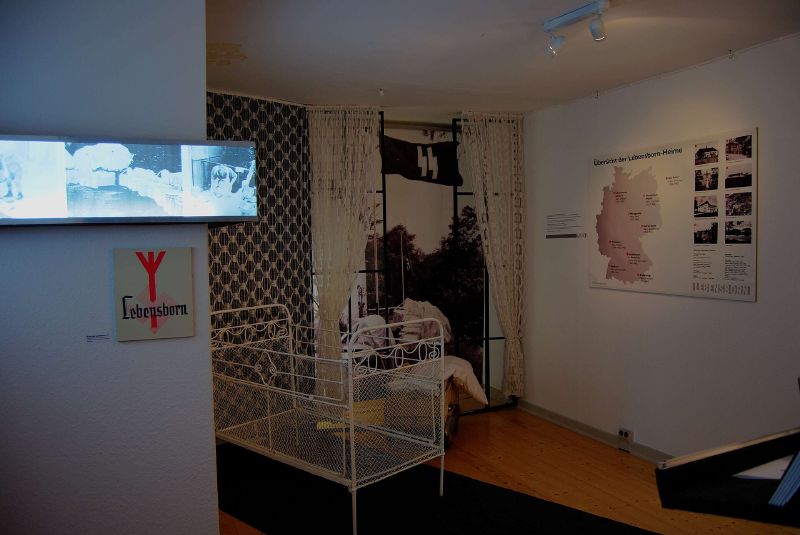
Adults born under the Nazi programme Lebensborn now trace their birth parents by digging through old case files, visiting the homes where they were born, and finding each other. Heinrich Himmler set up the scheme in 1935 to raise the German birth rate. Later it took in children the SS judged racially “valuable” for adoption. Many of those children spent decades not knowing why their own families never made sense.
more
Gisela Heidenreich was born to an SS officer and a Lebensborn secretary. She only found out as a girl that the story of her birth was a lie. Her uncle called her an “SS bastard” when she was small, and nobody would tell her why. She has said she felt guilty for years before anyone explained she was a Lebensborn child.
Where the files sit
Himmler opened ten Lebensborn homes in Germany and nine in occupied Norway, using confiscated houses and requisitioned hotels. In the Norwegian homes, each registered child was issued a Lebensborn number and a file holding medical records. That is why a search for a birth family usually starts with a paper trail rather than a photograph.
Some of that paper only surfaced after 1990. Children who grew up in East Germany have found their Lebensborn background recorded in the Stasi’s own surveillance files, opened to the public after reunification. Folker Heinecke, taken from what is now Ukraine as a toddler because of his “Aryan” looks, only started looking for his birth family once the Berlin Wall came down. He travelled to the Ukrainian town where records suggested he had been found, and still had no answer. He visited houses where records suggested children like him had once been taken, and found nobody who knew anything. He has not given up. “I’ll keep looking,” he said.
What the search finds
Not every search leads to reunion. Ingrid von Oelhafen, taken from Slovenia at eight months old, was never returned after the war. “I have never been loved,” she has said of the loss it left her. Others found relatives only to meet silence rather than welcome. Kikki Skjermo, stigmatised as a “Nazi child” in a Norwegian children’s home, eventually traced her mother, who touched her only once, gently on the nose.
A support group called Lebensspuren, founded in Germany, now brings people through this together, comparing files and swapping leads on relatives. In Norway, roughly 8,000 Lebensborn children were registered. Hundreds were later confined to psychiatric institutions on the theory that their parentage made them “genetically bad”, and a Norwegian group has since pressed the state over that treatment.
Why the record stayed hidden so long
Shame kept the story quiet on both sides. Norway’s postwar government publicly vilified the children of Norwegian mothers and Nazi fathers. In Germany, a climate of shame suppressed discussion for decades after the war. Heidenreich now takes her account into schools. “We all need to be aware of what happened,” she has said, singling out younger generations.
For the adults still searching, the work is less about the history than about one missing fact: who their parents were, and why nobody told them.