Ole Kirk Christiansen bought a small carpentry workshop in Billund, Denmark, in 1916, and it made stepladders, ironing boards and footstools for sixteen years before it made a single toy. Orders for household goods dried up in the Great Depression, so in 1932 Christiansen started carving wooden toys instead, to cheer the children up, as he put it. Two years later a staff competition gave the workshop a new name: Lego, a contraction of the Danish leg godt, “play well.”
Christiansen had trained as a journeyman carpenter, one of thirteen children born to a farm labourer, before he ever bought the place. None of that explains the brick. The brick came from his son, and it took another twenty-six years to get its grip right.
From ladders to ducks
The workshop, called Billund Maskinsnedkeri, made furniture and tools alongside the stepladders before toys arrived at all. Once they did, the range ran to wooden cars, fire engines, pull-along chickens and quacking ducks, sold under the new Lego name from 1934. The brick that would define the company was still decades away.
A brick that would not grip
The workshop’s plastic arm produced a piece called the Automatic Binding Brick by 1949, cast in cellulose acetate with a hollow underside and no tube to lock it to the brick above. The shape borrowed from an earlier British toy, and for years it barely sold. What changed the brick’s fortunes was not a better material. It was Godtfred Kirk Christiansen, Ole Kirk’s son, hitting on the idea of a system of toys that would all fit each other.
The British design Godtfred had borrowed from had a name of its own: the Kiddicraft Self-Locking Building Brick, made by the inventor Hilary Page. Lego later paid Page’s estate in acknowledgement, after his death.
The patent that fixed the brick’s shape
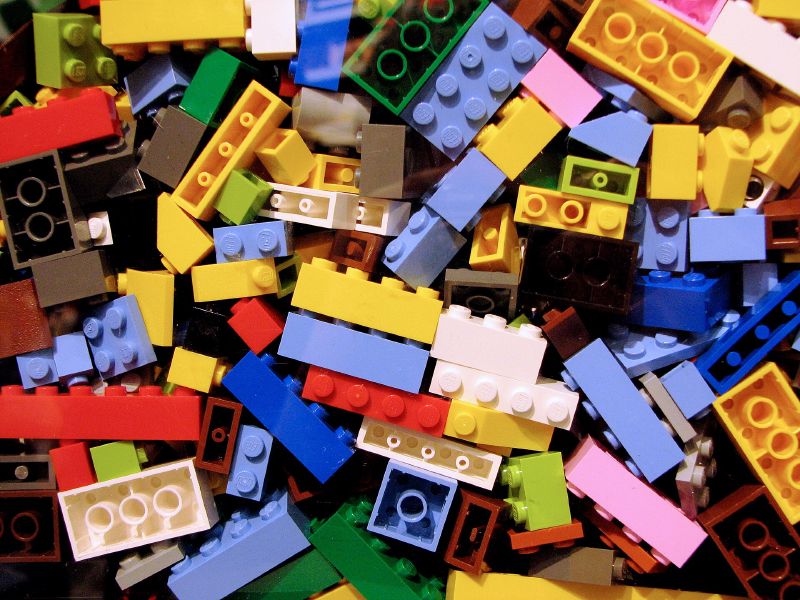
Godtfred filed for a patent on a new coupling in 1958. The grant came from the United States in 1961, for a piece the paperwork called a “toy building brick”: a rectangular block with eight studs on top and three tubes underneath. Smithsonian Magazine reported that the shape had barely changed since, nearly six decades on from the grant. Will Reed, who writes for The Brick Blogger, said no toy line before it had let every piece work with every other.
Lego’s coloured bricks first went on sale in the UK in 1955, before the new coupling existed.
One brick becomes a system
Lego kept building on the same coupling rather than starting over. Duplo, a brick twice the size for smaller hands, connected into the system through a patent Lego filed in 1971, and for a time the company sold Quatro bricks too, four times the standard size. In 1979 Godtfred took out a design patent for a “toy figure” with arms and legs that moved.
The figures picked up jobs before they had much of an identity beyond that. Firefighters and police officers arrived matched to the fire engines and squad cars sold alongside them. Gender came later, and unevenly. Early sets gave women a token role, a single pirate in a pirate set. The “Lego Friends” line aimed at girls launched only in 2012, and was hotly debated.
Ole Kirk Christiansen died in March 1958, months before his son filed the patent that made the family’s toy into the brick it is now. By 2009 a Lego spokeswoman, Charlotte Simonsen, was telling the Guardian that more than 400 million people would play with the brand that year. The company had by then produced 62 bricks for every person on Earth.