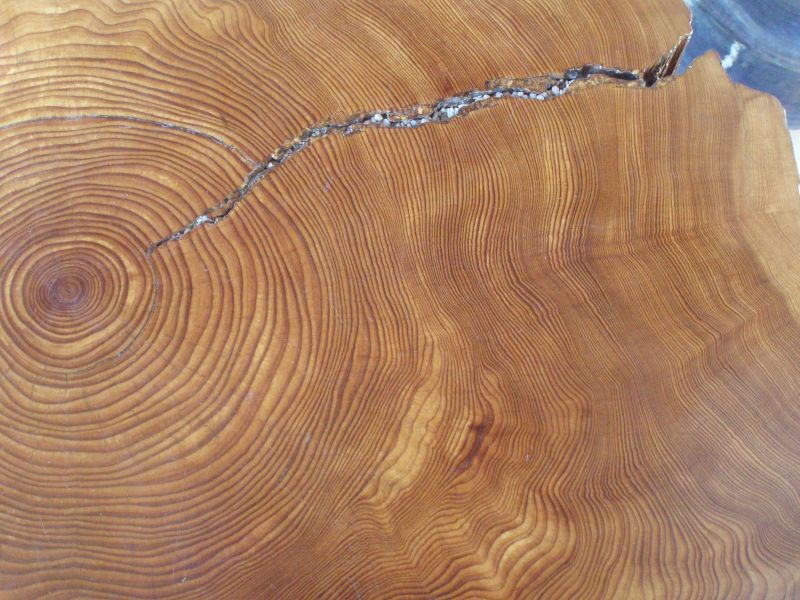
In a temperate climate a tree adds one ring for each year of growth. A wet growing season leaves a wide ring and a dry one leaves a narrow ring, so a thin band in the wood marks a dry year. The trick is working out which year. Scientists do that by matching the pattern of wide and narrow rings against other trees from the same region whose dates are already known.
more
One ring alone tells you a season was dry. A run of rings, lined up against other samples, tells you it was dry in a particular calendar year.
Why a single tree is not enough
The US National Park Service describes dendrochronology as the science of giving exact calendar dates to the yearly rings trees grow. It works because climate is regional. A dry summer thins the rings of many trees across an area at once, so different trees share the same sequence of wide and narrow bands.
That shared sequence is what gets cross-dated. A sample of unknown age is slid along a known record until its pattern locks into place. Rings also respond to temperature and cloud cover, not moisture alone, because those shape growth too.
Not every tree is useful. Conifers often give the most accurate readings, because their growth is sensitive to changes in climate. Trees in milder climates tend to grow uniform rings that are no good for precise dating. At Tonto National Monument in Arizona, several hundred samples yielded only a few confirmed dates, because the Salado people built mostly with undateable local wood, such as black walnut and sycamore.
An astronomer who was looking at the Sun
Andrew Ellicott Douglass, an astronomer at Lowell Observatory in Flagstaff, laid the groundwork in the early 1900s while studying how sunspots related to the Earth’s climate. He noticed that different trees carried identical ring patterns. By 1914 he had built a 500-year chronology for the Flagstaff area.
Clark Wissler of the American Museum of Natural History saw that the same method could date archaeological sites, and sent Douglass wood from prehistoric sites in New Mexico. In 1929 a single beam from Whipple Ruin in Show Low, Arizona, joined two separate chronologies. That link gave the first accurate dates for many sites in the Southwest.
What 800 years of British oaks show
The same logic works in Britain. A project led by the University of Oxford and Swansea University took core samples from hundreds of oaks across the UK, living trees and old timbers alike. Oaks grow a ring each year and respond strongly to how wet the summer was.
By measuring ring widths and the chemistry of the wood, the team rebuilt summer rainfall for more than 800 years. The Met Office’s own records cover only a few hundred.
The rings picked out decades of wetter-than-average summers from the mid-1200s to the early 1300s. That period coincides with great famines, including the Dantean anomaly, when crop failures came with the reported deaths of 20% of Europe’s population.
The researchers also found they could match timbers by the oxygen in the wood, which came from the rain that fell as the tree grew. That gives a new way to date old buildings. A Swansea student, Bethan Roberts, is using it on the oak beams of the Grade II-listed Tithe Barn in Abergavenny.
From one region to the whole planet
Put enough chronologies together and the rings map drought worldwide. A study from Columbia University’s Earth Institute, reported in Nature, used drought atlases built from tree-ring data covering the past two millennia. Edward Cook of Columbia’s Lamont-Doherty Earth Observatory assembled most of them.
The tree rings track soil moisture, and they matched what climate models predicted. From 1900 to 1949 they showed the clearest human fingerprint on drought, with regions from Australia to the Mediterranean drying. “These tree-ring reconstructions let us go back in time,” said Kate Marvel, the study’s lead author.
Gregory Quetin of Stanford, who was not involved, put the mechanism plainly: the trees respond to temperature and to whether rain falls. That is the whole method. A narrow ring is one tree’s record of a thirsty summer, and a forest of them agreeing is how you know which summer it was.