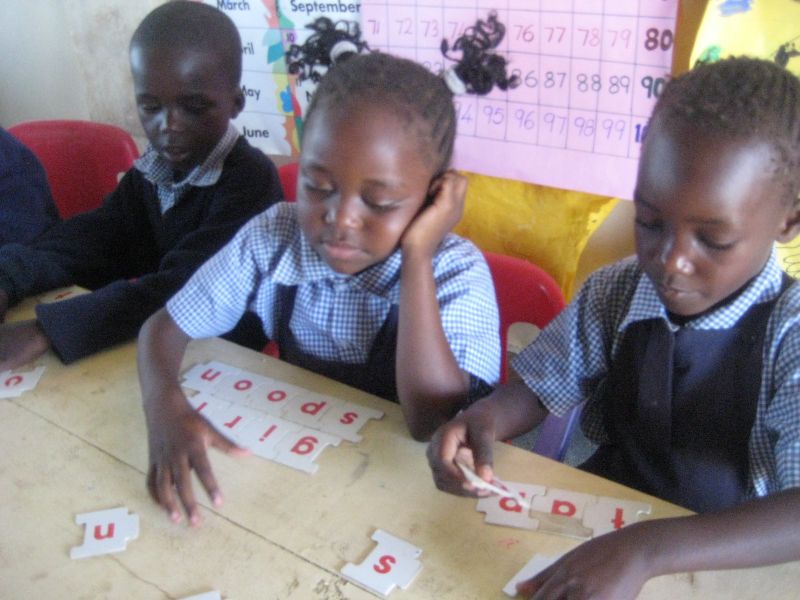
A phonics programme teaches a child to match individual letters, and pairs of letters, to the sounds they make, then blend those sounds together to say the whole word. Shown “c-a-t”, the child sounds out each letter in turn and hears the word “cat” emerge. That single skill, applied over and over, lets a young child sound out a written word they do not recognise.
more
Teachers call this decoding. It works in reverse too: a child who knows that “sh” makes one sound rather than two can use the same knowledge to spell a word, not just read one.
Starting with the sounds that unlock the most words
A phonics scheme typically begins with common single letters, for example “s”, “a”, “t”, “p”, “i” and “n”. A child who knows the sounds for “s”, “a” and “t” can already sound out and spell “at”, “as” and “sat”.
Letters that look alike, such as “b” and “d”, or sound alike, such as “b” and “v”, are kept apart in the early lessons so one does not get confused with the other before it is secure. Only once the single-letter sounds are established does a programme move on to letter pairs such as “sh”, “th” and “ee”, which represent one sound each despite being written as two letters. Researchers estimate that a child needs to learn somewhere between 60 and 100 of these letter-sound relationships, alongside a small set of irregular words that do not follow the pattern, before they can read independently.
What a daily lesson looks like
At St Peter’s Primary School in Somerset, daily phonics lessons begin as soon as a child starts in Reception, the first year of English primary school. Janine Ashman, the school’s director of learning, says using one consistent scheme rather than switching between methods lowers the mental load on a child who is already decoding, understanding and remembering a word all at once.
Teaching phonics is a statutory requirement in English primary schools. The government has validated 45 systematic synthetic phonics programmes after three rounds of independent evaluation.
Why England made one method compulsory
The approach schools are required to use is called systematic synthetic phonics: systematic because sounds are taught in a fixed order, synthetic because children blend, or “synthesise”, individual sounds into a word rather than recognising whole words by sight. England adopted it after the 2006 Rose Review concluded it was the most effective way to teach early reading, and it has been government policy since.
Research at Aston University, led by Dr Laura Shapiro, found that combining synthetic phonics teaching with separate training in phonological awareness, a child’s sense of the individual sound units inside a spoken word, is the most effective way of teaching early reading. The stakes are financial as well as educational: reading difficulties are estimated to cost the UK taxpayer £2.5 billion a year.
Schools check the approach is working with a phonics screening check in year one, when most children are five or six. A child reads a list of 40 words aloud to a familiar teacher, who records which ones they decode correctly. The most recent government statistics put 79% of children at that age at the expected level, a rise of four percentage points on the previous year.
Where the evidence splits
The Education Endowment Foundation, which reviews education research for English schools, rates phonics as having a positive impact worth roughly five months of extra progress on average, with an especially strong effect for children from disadvantaged backgrounds and lower attainers. It adds one caveat: phonics improves the accuracy of a child’s reading, but not necessarily how well they understand what they have read.
That caveat is at the centre of a live dispute. In 2022, researchers at UCL’s Institute of Education, including Professor Dominic Wyse, argued in a study covering multiple systematic reviews and international test data that England’s narrow focus on synthetic phonics was “not underpinned by the latest evidence”. About 250 signatories backed a letter to the then education secretary calling for schools to be free to use a wider mix of approaches rather than one mandated method. Supporters of the current system point to gains for disadvantaged pupils as evidence it should stay.
Spreading beyond England
The method is not confined to one country. In Australia, the state of Victoria has followed New South Wales, Queensland and South Australia in requiring every government school to teach phonics, with 25 minutes of explicit daily instruction from a child’s first year of school through to year 2.
For a child learning to read, the method looks the same wherever the mandate comes from: fewer sounds to guess at, one order to learn them in, and a way to sound out any word that follows the pattern.