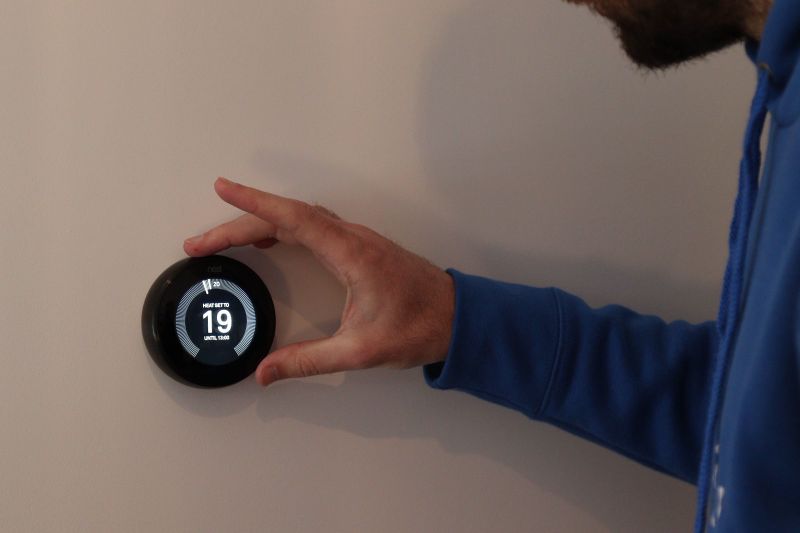
A smart thermostat learns a household’s routine by copying the adjustments people already make, rather than by being taught any explicit rule. If a household turns the heating off at a certain time, a learning model can pick that up. The more capable models also work out when the house is usually occupied, and use that to predict the next day instead of only reacting to it.
more
Not every smart thermostat does this. Which? has tested 32 models, and only some of them carry a “learning” mode. Others offer program modes, a schedule someone sets by hand.
What learning actually means
The Energy Saving Trust separates three things a smart heating control can do. It can take the temperature a person types in, learn from how that person adjusts it, or react to outside data such as a weather forecast. Only the middle one is learning.
How it knows when nobody’s home
Copying the dial is only half the story. Many smart thermostats also use geofencing: the app tracks a phone’s location and can tell the thermostat its owner is heading home, so the heating comes on before anyone walks in. The same feature can switch the heating off if a phone leaves the house and nobody remembered to do it by hand.
Geofencing depends on the phone rather than on any pattern in the household’s behaviour. Which?’s spec sheets list “GPS tracking” as a feature separate from “learning”. The Google Nest Learning Thermostat and the Tado Smart Thermostat X both carry both. A plainer model such as the Bosch Room Thermostat II sticks to program modes, with neither.
What it costs, and what it saves
Manufacturers commonly claim a smart thermostat can cut a heating bill by around 10%. Jo Alsop of the consumer advice site the Heating Hub told BBC Radio 4’s Sliced Bread that various studies back that figure up. Tado claims more: savings of up to 28%, which it calls “scientifically proven”. Alsop said that number came from a household that had left its thermostat set at 20 degrees for most of the day. Most of the saving there came from geofencing, she said, rather than from the thermostat learning anything.
She worked the sum through for one Sliced Bread listener, Wendy, whose home already had cavity wall insulation, a boiler that was already 12 years old, and thermostatic valves fitted to every radiator. Even allowing for a saving of around £50 a year, Alsop reckoned a £200 smart control with installation would take six years to earn itself back. A basic smart thermostat starts at around £50 to £60. Harry Kind, a consumer affairs journalist, told the programme that a larger house with several heating zones, plus added smart radiator valves, can run to £200 to £300 or more.
The trade it actually makes
The Energy Saving Trust makes a point that cuts against the sales pitch. A thermostat that has learned a household’s habits can use more energy as well as less, by making the house more comfortable rather than cutting its carbon. Suppose it starts heating the rooms earlier each morning because that is when people usually get up. It has learned the routine correctly, and it may be using more energy as a result.
Some functions, the Trust notes, only make the system more efficient. Load and weather compensation adjust a boiler’s flow temperature, and they do not need a smart thermostat. Sliced Bread found a catch. A boiler older than eight years cannot talk to a compensation controller, and Wendy’s boiler is one of them. Learning the routine buys a household some quiet. It does not automatically buy a smaller bill.