Stage costumes have to come off fast and last a long time. On Broadway, dressers strip performers head to toe in seconds, eight times a week. On the Melbourne club circuit, two performers told the Guardian how they wash, mend and alter their own outfits for years.
The trick in both places is the same. A costume is made to be got out of quickly, and then kept going.
A dresser for every track
On Broadway, dressers do the changing. Each one is assigned one or more cast members to follow through the whole performance, and joins a team for quick changes in the big numbers. Playbill counted 17 dressers on Aladdin and 12 on Mean Girls, against five on Chicago and two on Come From Away.
Barry Hoff has done the job for three decades. His first dresser job was the 1991 musical Nick & Nora. Since then he has worked on shows including Sunset Boulevard and The Capeman, where he dressed Marc Anthony and Ruben Blades. On Aladdin he dresses Jonathan Freeman, who plays Jafar.
Layers, then snaps
Many quick changes start well before the wings. Performers put on several costumes at once, one over another, which the trade calls underdressing. So a change is often a fast removal rather than a full undressing and redressing.
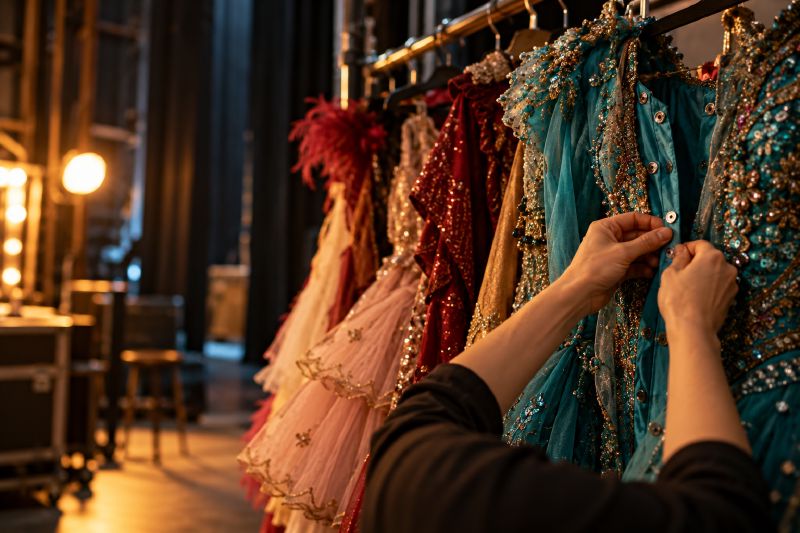
That layering only works if each layer stays shut until the right moment. Before a show, dressers snap up every seam of every layer by hand. At Ain’t Too Proud, each seam of a pant leg carries at least 10 snaps, about 40 for one pair of trousers. A seam left loose risks an early reveal, and the performer can miss part of a number.
Four changes in under seven minutes
The Act 2 opener of Aladdin, “Prince Ali”, shows what the system can do. Ensemble members change three times in the one number, and they start it wearing four costumes stacked on top of each other.
In less than seven minutes, Hoff completes four quick changes between two performers. For the first, he pulls the side snaps apart from the cuff upwards in three pulls to the knee, then grabs the shoulder and takes the top layer off in one movement. He told Playbill that with each change the costume on stage grows “more beautiful and wilder”.
What keeps a costume going for years?
Repair, mostly. The Guardian spoke to two Melbourne performers who wear their costumes for years, kept working by rounds of mending and alteration.
Rian Difuntorum performs in drag as Aysha Buffet at least four times a week. That means owning enough costumes to stand repeated wear. Her mainstay is the catsuit, and she owns about half a dozen. She told the Guardian that a seam or a zip often bursts, and she mends a great deal to keep her outfits strong.
Ease of changing matters on the club circuit too. Difuntorum said the outfits she wears least are usually the ones she cannot get into alone.
The DJ and musician Tanzer washes most of her sequinned looks in the machine, inside a delicate bag, because she sweats hard on stage. She wore one silver sequin catsuit almost 100 times. She retired it only when the fabric had worn so thin it began to fall apart.
Alteration buys a costume a second career. Tanzer had a 2016 dress by the designer Alice Edgeley remade as a catsuit for a new music video. Sequins wear out other kit as well: she said they keep shredding her headphones.
Even then, a costume rarely ends in a bin. Difuntorum turns old pieces into patterns for new ones or passes them to other performers, and Tanzer gives hers to friends or a Melbourne costume shop.