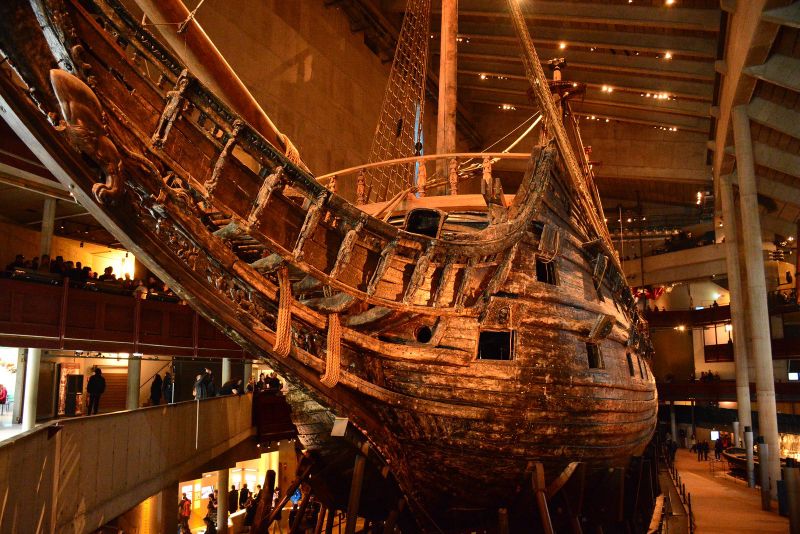
Sweden raised Vasa after an engineer found the wreck and divers confirmed the hull had survived. Marine engineer Anders Franzén spent years searching old harbour records for the ship’s resting place and located it in 1956. Divers who went down afterwards found the hull still largely intact.
more
Why the pride of the Swedish navy rolled over in a gust of wind
On 10 August 1628, Vasa set out from Stockholm on its maiden voyage carrying 64 bronze cannons, ordered by King Gustav II Adolf. The king watched from the shore as his newest warship went down within twenty minutes, nowhere near an enemy. The crowd that gathered to see it off had come to watch what one Archaeology magazine writer called “Europe’s most ambitious warship to date.”
An inquest that autumn concluded the ship had been unstable, though the reasons stayed disputed for years afterwards. One archaeologist who later studied the wreck traced the fault to the gun deck. It was too heavy, designed by someone with no experience building a ship carrying that much armament, and the king had rushed construction throughout. Management researchers later named a pattern after the failure, “Vasa syndrome,” arguing that the navy’s ambition for the ship’s elegance and firepower had outrun what its builders could deliver. Vasa was designed to carry 36 guns, and it sailed with twice that number.
The tribunal that heard the case, drawn from the Admiralty and the Privy Council, punished no one. Blame fell on the original shipwright, Henrik Hybertsson, who had already died, while the king who had pushed for more guns and less time faced no consequence at all.
Why the wreck sat on the harbour floor for three centuries
Salvage crews pulled up most of Vasa’s valuable bronze cannon within a few years of the sinking, working with early diving bells, and after that the wreck slipped out of public memory. It sat on the floor of Stockholm harbour while the city grew up around the water above it, until Franzén’s records search placed it again three centuries later.
What made the find worth pursuing was the water itself. The Baltic there is cold, dark and short of oxygen, conditions that kept out the shipworms and bacteria that would otherwise have stripped a wooden wreck within decades. By the time divers reached the hull, an estimated 95% of the original wood was still there.
How Sweden brought the hull back to the surface
The recovery ran over roughly two years. Divers dug six tunnels beneath the hull and threaded steel cable slings through them, so the wreck could be lifted without further damage to timber that had spent three centuries underwater. Crews made eighteen lifts across August and September 1959, walking the wreck up from about 105 feet to 52. For the last stage, divers closed the gun ports and plugged the remaining holes in the hull before the final pull towards dry land.
On 24 April 1961, Vasa broke the surface for the first time in 333 years. Bertil Daggfeldt, a Swedish naval officer who watched it happen, remembered the ship reappearing from the water almost totally preserved.
What was still aboard after 333 years
Archaeologists opened storage chests below deck that still held sailors’ food, clothing and belongings, left as they were the afternoon the ship went down. They recovered thousands of artefacts in all, along with the remains of at least 15 of the people who had been aboard.
Keeping the hull stable once it reached the air took decades of work. Conservators sprayed the timber continuously with a preservative compound from 1962 to 1979, replacing the water trapped inside the wood. Nearly ten years of slow drying followed, to stop the old timber cracking. Vasa moved into its purpose-built museum in Stockholm in 1988, and the museum opened to the public in 1990. According to the museum itself, it remains the only preserved 17th-century ship in the world.