Walter Gropius opened the Bauhaus in Weimar in 1919, and the Nazis shut it in 1933. In those 14 years a small German art school settled what most people still picture when they hear the word “modern”: white walls, glass, steel tube and no ornament.
more
The Victoria and Albert Museum ranks it among the 20th century’s most influential schools of architecture, art and design. Dezeen goes further and calls it the most influential art and design school in history.
An art school with no architecture
The name means “building house”, yet at first nobody taught architecture there. Gropius, a Prussian architect, founded it as a sort of art school, though one unlike any other.
His founding manifesto still put building first. Its cover carried Gropius’s own expressionist woodcut of a Gothic cathedral, and its opening line named the building as the final aim of all art.
What he wanted was a new kind of artist who could turn a hand to anything. He told students there was no essential difference between the artist and the craftsman. So they learnt pottery, printmaking, bookbinding and carpentry, and studied typography and advertising.
Mystics before minimalists
The early school was far from the rigorous place of its reputation. Wallpaper* describes a start that was diverse and a little chaotic, with Paul Klee and Wassily Kandinsky pursuing abstraction alongside photography, metalwork and theatre.
The painter Johannes Itten, one of its most influential early teachers, ran a preliminary course on colour and form that every student took. He dressed like a monk and followed Mazdaznan, a movement that promised to raise consciousness through body and spirit.
Women were kept out of the art studios and furniture workshops, which were reserved for men. They worked instead in pottery, ceramics and textiles.
Over the 1920s Gropius steered the school away from this eclecticism. It turned from handmade craft towards industry, joining art to technology and designing for mass production.
Prototypes for the factory
Gropius described the workshops as laboratories that refined prototypes for mass production. The objects that came out of them are still recognisable: Marcel Breuer’s tubular-steel Club Chair and the light fittings of Marianne Brandt. Wilhelm Wagenfeld’s desk lamp, a Bauhaus design, now stands beside a modern replica in a German museum.
Hopkins singles out one chair. He picks the 1927 MR Side Chair by Ludwig Mies van der Rohe, built from chrome-plated steel tube, leather and string, as the purest version of the tubular chair now found in boardrooms worldwide.
Thrown out, twice
Politics moved the school before it closed it. After the liberals who backed it lost local elections in 1924, the new conservative government cut its funding, and on 1 April 1925 the Bauhaus had to shut.
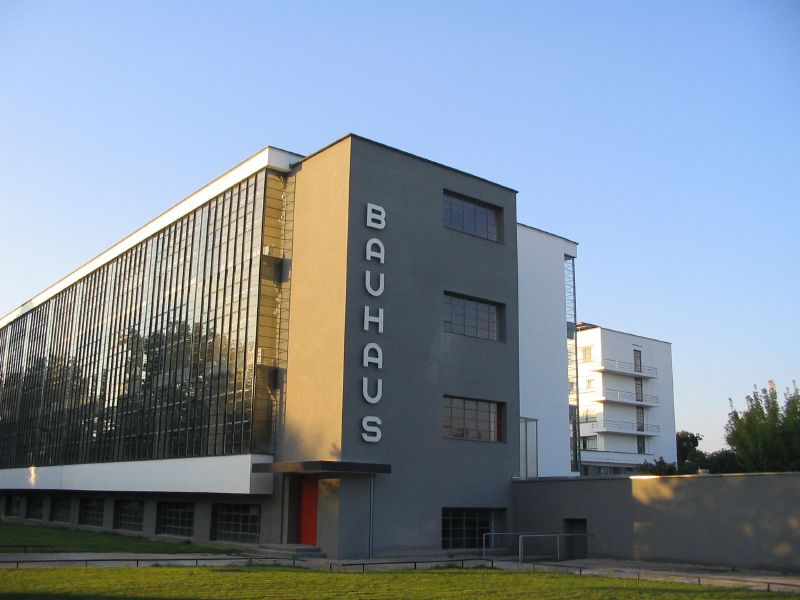
Dessau took it in, and Gropius designed its new home there. The V&A notes that each wing expresses its use: teaching rooms have small rows of windows, while workshops sit behind walls of glass. A century on, Wallpaper* argues the building still looks contemporary.
Under Hannes Meyer, who took over when Gropius left in 1928, wallpaper became the best-selling product and the school at last paid its way. Dessau’s council dismissed Meyer in 1930 for “communist tendencies”, and the Nazis won the local elections in 1931 on a promise to close the school. It moved to an old Berlin factory under Mies van der Rohe, and in 1933 Hitler shut it down.
The look that left Germany
Closure spread the school rather than ending it. Many of its members went abroad and taught Bauhaus ideas wherever they settled. In Tel Aviv, German Jewish immigrants built the White City, more than 4,000 buildings in the Bauhaus style from the 1930s on.
White walls that were not what they seemed
The famous white villas were meant to look like concrete. In fact, Wallpaper* reports, they were mostly brick, plastered to look modern, because concrete was still scarce and costly.
Mies van der Rohe was later mocked for something similar. Fire rules made him cover up his buildings’ real steel frames, so he fixed decorative I-beams to the outside. Wallpaper* reads both as a movement ready to trade actual integrity for the look of it.
That look won anyway. The BBC put it plainly as the school neared its hundredth year: its ideas still set the pattern for the way people live.