The Gulf Stream explains only part of why Europe is mild. Oceanographers Stephen Riser and Susan Lozier point to climate modelling studies that removed the Gulf Stream altogether. In those studies the temperature gap between western Europe and eastern Canada persisted. Winter in Ireland still runs about 20°C warmer than winter in Newfoundland, at the same latitude, and the current everyone credits for that gap explains less of it than the textbook version claims.
more
Where the idea came from
The 19th-century geographer and oceanographer Matthew Fontaine Maury was first to pin Europe’s mild winters on the Gulf Stream. He argued that the current fed heat to the westerly winds blowing toward north-west Europe, and warned that a weaker current would leave the continent with Arctic winters. Over the years the idea became almost an axiom, and it stayed largely untested.
Scientist and blogger Chris Rowan has traced how the idea hardened without new evidence behind it. One paper cited an older paper that in turn cited one older still, until nobody checked the original data. Seager traces the story to a book published in 1855 and calls it “the climatological equivalent of an urban legend.”
What the current actually does
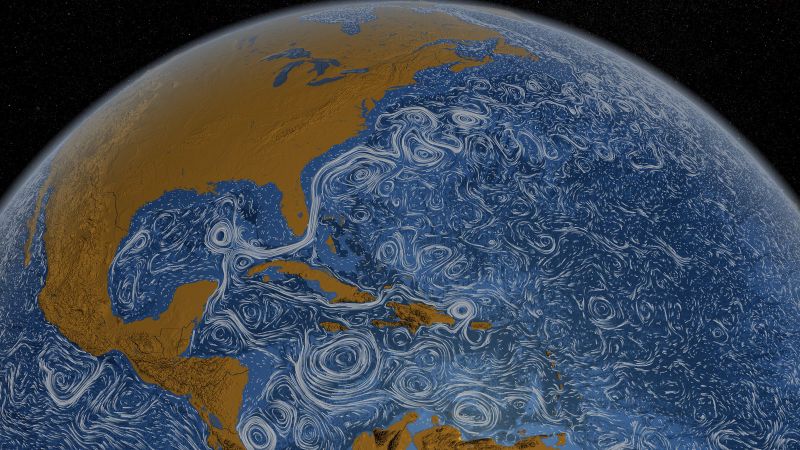
The Gulf Stream starts as warm water pooling in the Gulf of Mexico, then flows north along the eastern United States before merging with the Antilles Current. It pulls away from the coast near Cape Hatteras, North Carolina, and pushes north-east into the open Atlantic, where it widens and slows into the North Atlantic Drift that reaches European waters. Near Florida it moves roughly 30 million cubic metres of water a second, far more than the world’s largest rivers carry.
That current is the visible part of a larger loop, the Atlantic Meridional Overturning Circulation. Warm water travels north near the surface and gives off heat to the air above it as it goes, cooling as it does so. Evaporation leaves the water saltier and denser, dense enough that it sinks near Greenland and Iceland before flowing south again at depth. Across the whole loop, estimates put the heat released northward at over a petawatt, roughly what a million large power stations would generate running non-stop.
So what does explain the difference
Riser and Lozier’s own answer is not a single cause to replace Maury’s. They point to a mix of factors: the wider surface ocean, the Gulf Stream among them, large-scale atmospheric currents, and the difference in air pressure between the two sides of the Atlantic. London sits at roughly 51.5°N, close to the same latitude as Calgary, yet its average January temperature is near 5°C against Calgary’s averages below minus 10°C.
Even writers who credit the current hedge. One explainer lists the belief that the Gulf Stream alone keeps Europe mild as a common misconception. It names atmospheric circulation and the shape of the land as other factors. Another notes that ports on the Norwegian coast stay free of ice all year, and credits the current for it.
None of this makes the Gulf Stream irrelevant. It means the current has been asked to carry more of the explanation than the evidence supports.
Where the current still leaves its mark
On Scotland’s west coast, the warmth is not in dispute. Logan Botanic Garden, in Galloway, grows plants that would not survive anywhere else in Scotland, and frost and snow rarely reach it. The Gulf Stream runs close enough inshore there to keep the local climate mild.
The Gulf Stream moves a vast amount of heat. What Riser and Lozier dispute is how much of the credit for Europe’s winters it can claim.