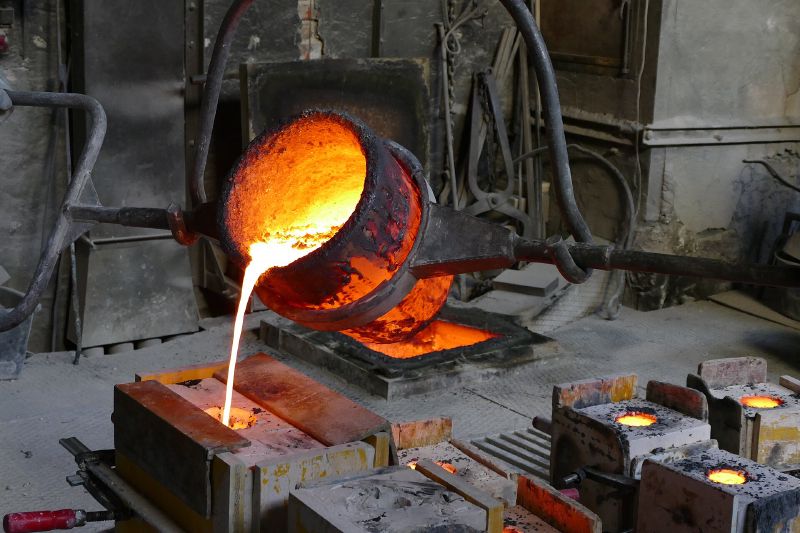
A sculpture goes into a foundry as wax and comes out as bronze, and the two forms never touch. The wax copy is buried inside a mould, heated until it melts and drains away, and the molten bronze fills the space it leaves behind. The method takes its name from that one step: the wax is not removed so much as lost.
more
How old is the technique, and where Benin fits in
The Guardian’s Jonathan Jones writes that the method was first used in ancient China, and that Greek and Roman sculptors later relied on it to give their bronze figures lifelike detail. In the West African kingdom of Benin, casters worked in bronze, brass, and sometimes copper from before the 13th century. Its royal court commissioned large-scale bronze work under Oba Ewuare I, who ruled from around 1440. His grandson, Oba Esigie, likely commissioned more than 850 cast reliefs to sheath the columns of the royal audience court, after a civil war and an attempted invasion by the kingdom of Idah. Esigie valued the craft enough to raise the head of the royal casting guild to the rank of privy counsellor.
Each new Oba’s first commission honoured his predecessor with a bronze head for the royal altar, and a hole on top of each head once held a carved ivory tusk. One such head was taken from a royal shrine during the 1897 raid on Benin by Ralph Locke. He gave it to a museum in Exeter after he moved there to become the city’s prison governor.
How the wax copy is made
At the V&A Museum in London, curators explain the process by starting with a plaster mould built in sections around a finished statue. Hot wax poured into that mould comes out, once it cools, as a hollow copy whose wall thickness matches the bronze skin the finished piece will carry.
Benin’s casters worked more directly. They modelled the figure in wax itself, then wrapped that wax model in a layer of fine clay before packing coarser clay around it to build the outer mould. The fine clay layer captured detail precisely enough that the artists rarely needed to add texture to the bronze afterwards. The weave of a cloth or the plait of a rope was already there in the wax. Because each Benin mould was broken to free the casting inside, no two heads that survive today are identical.
Inside a modern foundry
A contemporary foundry adds steps the V&A’s demonstration skips. The sculptor’s original goes into a flexible rubber or silicone mould rather than a plaster one, and that rubber mould can be reused to cast several wax copies of the same figure. Wax rods called sprues are attached to the wax copy before it goes into its ceramic shell. One set carries the molten bronze in, and another, called vents, lets trapped air and gas escape as the metal arrives.
The shell itself is built up in layers of ceramic slurry and takes hours or days to cure before it goes near a kiln. Firing the shell to somewhere between 800 and 1,500 degrees Fahrenheit drives the wax out through those channels. The bronze itself, an alloy of copper and tin, goes in molten at around 2,000 degrees Fahrenheit. Once it cools and the shell is broken away, a foundry worker chases the surface by hand and applies a chemical patina before the piece leaves.
Why the method sometimes loses more than the wax
Not every attempt at this process has gone as planned. Leonardo da Vinci ran into trouble with it on a scale nobody had attempted before. In 1482 he wrote to Milan’s ruler, Lodovico Sforza, offering to cast a bronze horse in memory of Lodovico’s father. By the time Lodovico’s ambitions had grown to match the commission, the horse alone was to stand more than 23 feet high and take 100 tons of bronze.
Leonardo turned down the traditional lost-wax method for the job. It shaped the wax directly over a clay core, so once the wax melted away and the bronze took its place, the clay original went with it. He spent roughly a decade designing an alternative that would protect his full-scale clay model instead, working through the details in notebooks that still survive.
The clay horse itself never became bronze. Leonardo finished the full-scale model by May 1491 and unveiled it at a betrothal ceremony two years later. In 1494, though, the metal set aside for the casting was sent away to be made into cannon instead. When French troops took Milan in 1499, their bowmen used the abandoned clay horse for target practice until it cracked apart.