How three scripts on one stone cracked the code
more
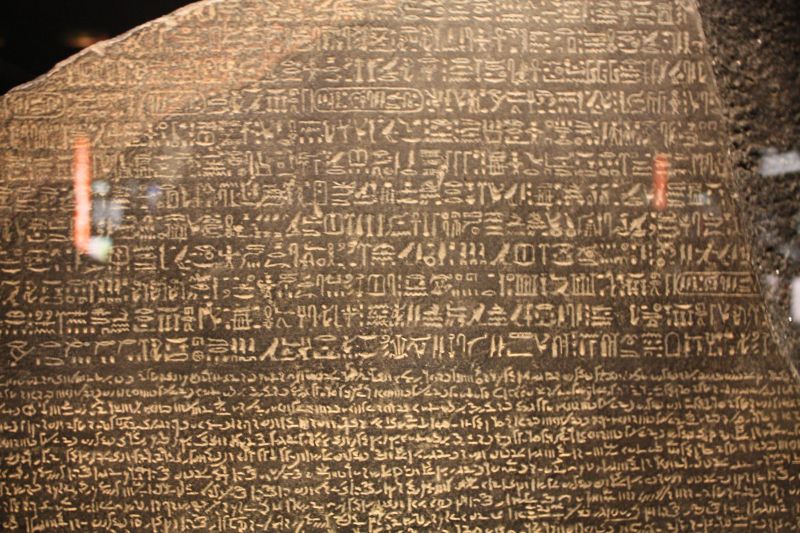
The Rosetta Stone, a slab of speckled grey stone carved with one unremarkable tax decree, gave scholars back a writing system that had sat silent for centuries. The decree runs three times down the stone: once in hieroglyphic script, once in the everyday Egyptian script called Demotic, and once in ancient Greek. Because scholars of the day could already read Greek, the stone offered a way in.
It should have been quick work. Early observers thought the match would take a fortnight. It took twenty years, according to the historian Edward Dolnick, author of a book on the decipherment.
What the decree actually says
The text itself carries no mystery. A council of priests at Memphis issued it in 196 BC to mark the anniversary of the coronation of the king Ptolemy V. It lists the tax concessions and gifts he had granted to Egypt’s temples. Dolnick calls it “a propaganda poster carved in stone.”
Richard Parkinson, of the British Museum’s Department of Antiquities, has described cracking the stone’s two languages and two scripts as a “hideously complicated affair.” What scholars found once they had cracked it disappointed some of them. Parkinson calls the result “one of the great disappointments”: rather than the mystical symbols people expected, hieroglyphs turned out to be “a fairly efficient, fairly normal writing system.”
Why the writing had gone quiet
Hieroglyphs first appeared around 3100 BC and served Egypt for roughly three thousand years. By Ptolemy V’s reign, priests still used the script for temple walls and monuments, while ordinary Egyptians wrote in Demotic, the simpler script derived from it. The last hieroglyphic inscription anyone has found dates to 394, and the last Demotic text to 452. Once the priests who could read either script had died out, nobody replaced them.
Without a key, Europe filled the silence with theories rather than evidence. The 17th-century German scholar Athanasius Kircher claimed to have deciphered hieroglyphs, and rendered single signs as whole paragraphs of philosophy, convinced each one hid a secret about the universe. He was wrong throughout, and his confidence sent generations of later scholars down the same dead end.
A find made in a hurry
The stone surfaced by accident. In July 1799, French troops occupying a fort near the Delta town of Rosetta were rushing to shore up its defences before a battle with Ottoman forces. As they tore down a wall built from salvaged temple stone, they found a slab covered in three kinds of writing. Napoleon’s Egyptian campaign had brought more than 160 scholars along with the army. Word of the find reached them quickly, and Lieutenant Pierre-François Bouchard is usually credited with recognising what the soldiers had.
France did not keep the stone for long. Britain beat France in Egypt in 1801, and the Treaty of Alexandria that ended the fighting required France to hand over its Egyptian antiquities. The stone reached London in 1802, and the British Museum, which has held it ever since, put it on display almost immediately.
The race nobody won outright
Two men made the real progress: the English physicist Thomas Young and the French linguist Jean-François Champollion. Young began working the stone in 1814. He noticed that the oval frames called cartouches enclosed royal names, matched the Greek “Ptolemy” to one such frame, and worked out the sound value of several signs from the match. He published a tentative alphabet anonymously in the Encyclopaedia Britannica in 1819, and argued that Demotic was simply a cursive form of hieroglyphs.
Young’s limit was an assumption he would not drop. He believed the signs only carried sound values for foreign names such as Ptolemy’s, and refused to accept that native Egyptian words worked the same way. Champollion did not share that assumption, and he came to the stone already knowing the last surviving form of the Egyptian language. He had learned Coptic, along with Latin, Greek, Arabic, Hebrew, Syriac and Chaldean, by his teenage years, and held a professorship at the Royal College of Grenoble from the age of nineteen.
Building on Young’s reading of “Ptolemy”, Champollion used a newly found obelisk from Philae, carrying the cartouches of both Ptolemy and Cleopatra, to test and extend the phonetic values. The decisive case was the name “Ramesses”. Champollion read a sun-disc sign that writes the name of the god Ra, followed by phonetic signs completing the name. He realised the ancient scribes had been recording an ordinary spoken language, not encoding hidden meaning.
The announcement, and what followed
Champollion is said to have burst into his brother’s office in September 1822 shouting “Je tiens mon affaire!” (“I’ve got it!”), then fainted, and to have taken five days to recover. He set out the breakthrough to a room of his peers in Paris roughly two weeks later. Ilona Regulski, who curates Egyptian written culture for the British Museum, says the trilingual decree reflects “a very multicultural society” in which formal documents in more than one language were routine.
The stone itself never gave up its whole text. Of the original, taller slab, only 14 lines of hieroglyphic script survive against 32 of Demotic and 53 of Greek. The missing top and lower-right sections have never turned up. What survived was still enough. Once Champollion’s alphabet let scholars work through funerary texts and temple inscriptions, and medical papyri such as the Edwin Smith and Ebers documents, Egyptian religious life, everyday business and medicine stopped being guesswork.
The British Museum has marked the find twice over. It staged one exhibition for the stone’s own bicentenary, which Parkinson called a chance to show visitors “the full impact it had on our knowledge of ancient Egypt”. It published a second, in 2022, built around the bicentenary of Champollion’s decipherment. Calls to send the stone back to Egypt have come again and again. It is still in London.