In 1950, Alan Turing dismissed the question “Can machines think?” as “too meaningless to deserve discussion” and replaced it with a game that gave a judge something to score. His paper proposed a party game: an interrogator questions a hidden person and a hidden machine by typed message, and the machine passes if the interrogator cannot reliably tell which is which. It became known as the Turing test.
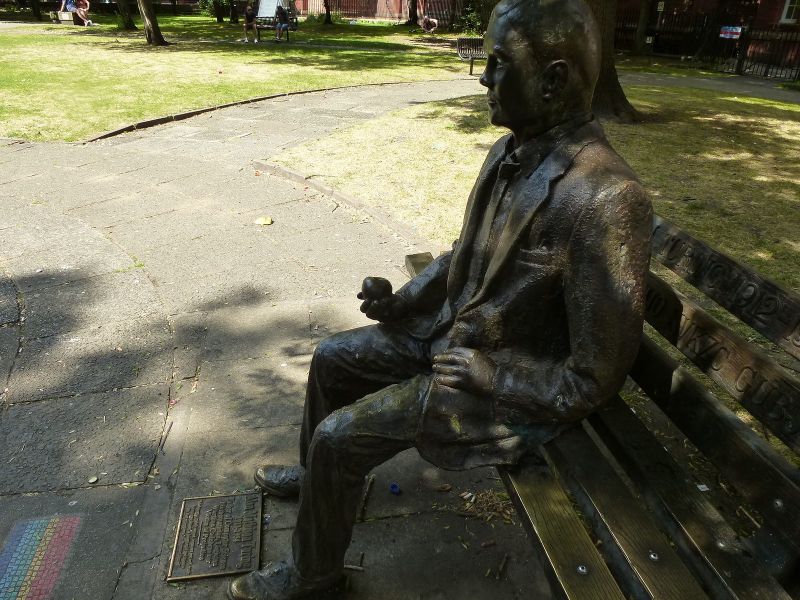
more
Turing wrote out his own worked example of a passing exchange. When asked to add 34,957 and 70,764, his imagined machine paused for thirty seconds and answered 105,621. The true sum is 105,721. A machine that never slipped would give itself away as a machine. The error in the transcript reads like one Turing planted on purpose.
The parlour game behind the test
The imitation game was not Turing’s own invention. It started as a Victorian parlour trick: a judge questioned a hidden man and a hidden woman through handwritten notes and had to say which was which. The man, meanwhile, tried to pass as the woman. Turing’s contribution was to swap one of the two players for a machine. If the judge could not tell the machine from the human, he argued, it would be reasonable to conclude that the machine was intelligent.
What counts as a passing score?
Wired describes the usual pass mark: a computer passes if it fools at least 30 percent of the judges questioning it. The philosopher Daniel Dennett later called the whole manoeuvre a philosophical conversation stopper, in that it let researchers agree on what would count as evidence of thought without ever settling what thought actually is.
The man behind the question
Turing spent much of his early life apart from his parents, because his father worked in the British administration of India. At 13 he was sent to Sherborne School in Dorset, where he taught himself relativity well ahead of the syllabus. A close school friendship with a fellow pupil, Christopher Morcom, ended when Morcom died suddenly of tuberculosis. Turing wanted to believe that his friend’s mind somehow lived on. He won a scholarship to King’s College, Cambridge, took a mathematics degree with distinction, and was elected to a Fellowship there at 22.
In 1936 Turing published the paper now credited as the foundation of computer science, setting out a “Universal Machine” able to carry out any set of instructions fed to it. During the Second World War he worked at Bletchley Park, where his section, Hut 8, broke the German submarine codes that mattered most to the Battle of the Atlantic. He then designed an early electronic computer, the Automatic Computing Engine, but left the National Physical Laboratory in 1948, before a working version was built. He moved on to the University of Manchester, where he wrote his 1950 paper two years later.
The British government later convicted Turing of gross indecency, and he was chemically castrated. He died at 41.
Wired has credited the codebreaking Turing did at Bletchley Park with saving an estimated 14 million lives during the war. It has also called his persecution severe enough that it may have driven him to his death.
What today’s chatbots haven’t settled
ChatGPT’s release in November 2022 put Turing’s question back in front of the public, 72 years after he first asked it. The reaction split fast. The science fiction writer Ted Chiang called the new chatbots “a blurry JPEG of the web,” and the AI entrepreneur Gary Marcus dismissed the same technology as “autocomplete on steroids.”
The linguist Noam Chomsky went further, calling it “something like the banality of evil.”
None of those verdicts answers the question Turing tried to sidestep in 1950: whether a convincing answer and a thinking one are the same thing at all.