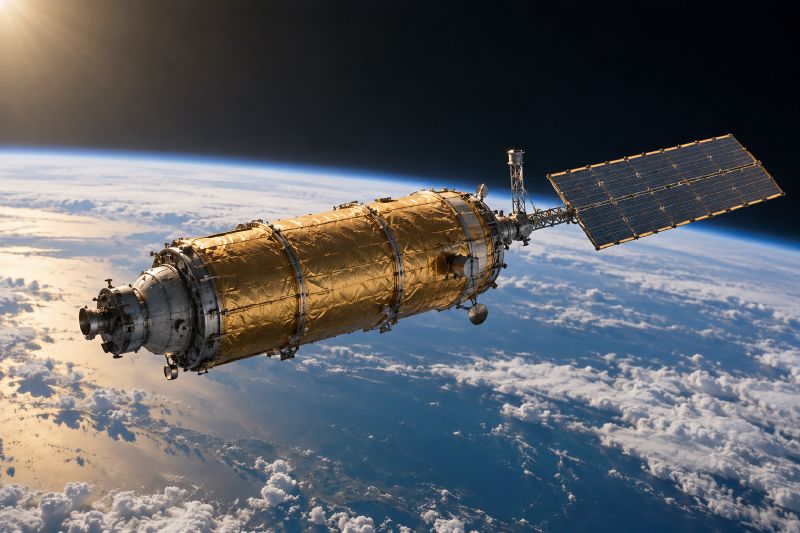
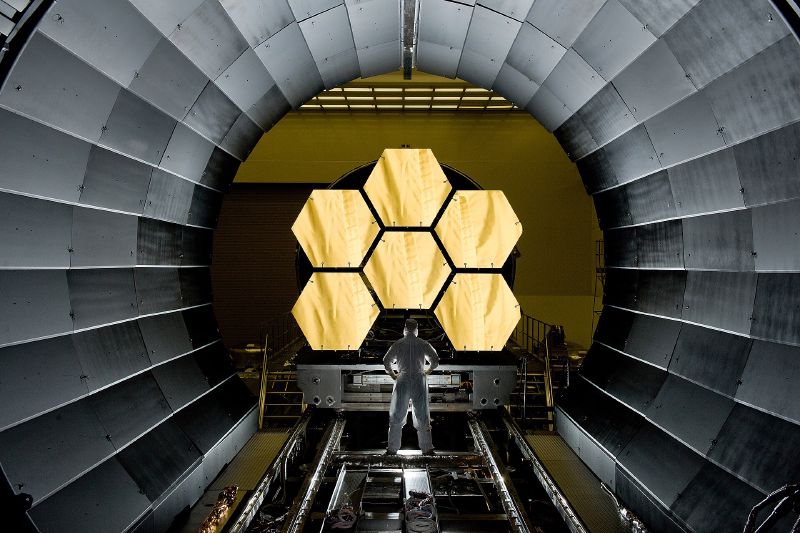
Webb’s primary mirror spans 6.5 metres, built from 18 gold-plated hexagonal segments fitted together like a honeycomb. Hubble’s is a single 2.4-metre disc. The bigger mirror gathers more than six times as much light, so Webb can record a faint object roughly six times faster than Hubble ever managed.
more
Size is only half the story. Webb observes wavelengths from 0.6 to 28.5 micrometres, stretching from the red edge of visible light deep into the mid-infrared. Hubble’s optics cover 0.09 to 2.5 micrometres, mostly ultraviolet and visible light. That difference matters because the oldest galaxies emit visible and ultraviolet light that the universe’s expansion has stretched into the infrared by the time it reaches Earth. Seeing that light at all means observing in the infrared.
Why Hubble’s eye ran out of wavelength
Nobody designing Hubble knew galaxies had formed as early as they did. Mark McCaughrean, senior adviser for science and exploration at the European Space Agency, says the evidence only turned up in the 1980s, after Hubble’s science goals were already fixed. Even a redesign would not have helped much, because the infrared detectors needed to prove it did not yet exist.
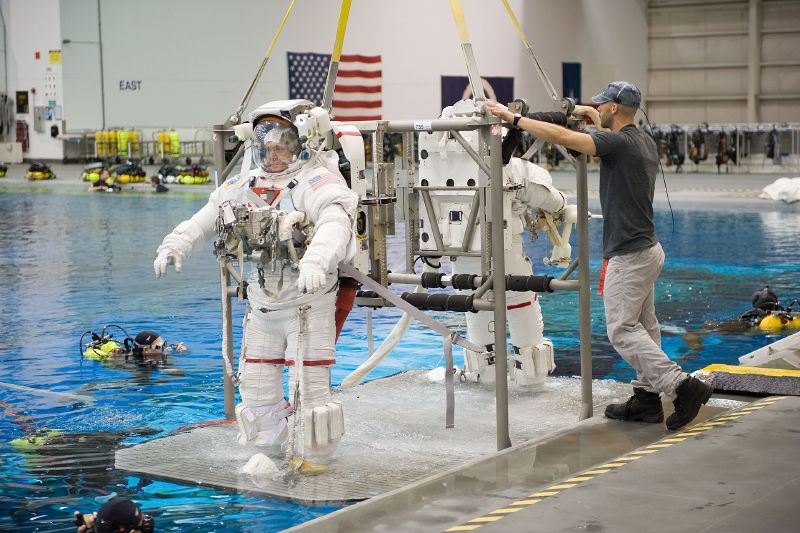
McCaughrean was one of the people who built them. As a PhD student at the University of Edinburgh in the 1980s, he worked on one of the first two-dimensional infrared cameras. It had 58 by 62 pixels, thousands of times more data than the single-pixel scanners everyone else was using. He later helped build NICMOS, the infrared camera fitted to Hubble in 1997 during its second servicing mission, which carried three sensors of 256 by 256 pixels each. Webb’s detectors run to 2,000 by 2,000 pixels apiece, and there are several of them. Webb, McCaughrean says, now carries “more infrared pixels [than] Hubble had optical pixels” at launch.
Randy Kimble, a project scientist on Webb who previously worked on Hubble’s instruments, including its Wide Field Camera 3, puts the improvement at “a factor 10 to 100” over earlier instruments. For some mid-infrared observations, he says, the advantage is closer to a thousandfold. The camera Kimble helped build for Hubble had already set a record of its own. It caught GN-z11, a galaxy as it looked when the universe was about 400 million years old, roughly 3% of its current age.
What Webb found once it looked
Webb broke that record within months of starting full science operations after its December 2021 launch. Two teams spotted GLASS-z12, a galaxy roughly 50 million years older than GN-z11. Other observations turned up much larger numbers of candidates, some dated to as little as 180 million years after the Big Bang. Jeyhan Kartaltepe, an astrophysicist at the Rochester Institute of Technology, says the telescope keeps finding galaxies “bright enough for us to detect.” People were surprised, she says, at how many there were and how easy they were to find.
Webb’s first released image, of the galaxy cluster SMACS 0723, held a further surprise. Erica June Nelson, an astronomer at the University of Colorado Boulder, spotted six elongated, dust-reddened galaxies from the universe’s first 500 million to 700 million years. She nicknamed them “big honking red disks.” Her team put each one at ten billion solar masses or more, with the largest holding perhaps 100 billion, on a par with the Milky Way.
That size is the problem. Standard cosmology has dark matter clumping into haloes first, dragging ordinary matter in behind it. Most models put that process at one to two billion years before a galaxy the size of the Milky Way can form. Michael Boylan-Kolchin, a theoretical astrophysicist, says the numbers make galaxies that size “really hard” to form without breaking “our current models of cosmology.”
Priyamvada Natarajan, a theoretical astrophysicist at Yale University, is less alarmed. “No data at the moment has broken the universe,” she says, while allowing that “interesting potential tensions” are emerging at different scales.
How the cameras manage the job
Two instruments carry most of the load. NIRCam, Webb’s main imager, splits near-infrared light into separate wavelengths, which lets researchers work out what a galaxy is made of rather than just its shape. It also carries a coronagraph that blocks starlight so it can photograph faint objects, such as planets, orbiting a bright star. MIRI, the mid-infrared instrument, picks up longer wavelengths suited to cooler, dustier targets, such as stars still forming inside clouds of gas. Between the two, Webb is sensitive enough that if NIRCam were your eyes, you could register the heat of a bumblebee sitting on the Moon.
That sensitivity has a price. Webb has to stay extremely cold, or its own heat would drown out the faint signals it is trying to catch. A five-layer sunshield, roughly the size of a tennis court, blocks warmth from the Sun, Earth and Moon, holding the telescope near minus 223 degrees Celsius. MIRI runs colder still, chilled by its own dedicated cryocooler to close to minus 266 degrees Celsius.
There is a trade-off buried in all that infrared sensitivity, too. Despite Webb’s bigger mirror, it generally will not resolve finer detail than Hubble does in visible light, because resolving power falls as wavelength grows longer even as it rises with mirror size. Webb was built to see fainter and older objects, not sharper ones.
What Hubble still does
None of this retires Hubble. NASA describes Webb as a telescope that “complements and extends the discoveries” of Hubble. Hubble’s range also reaches into the ultraviolet, where Webb’s does not.
The same reach that pulls in light from 13 billion years ago also has closer uses. Webb has tracked cloud bands on Neptune, sharp enough to trace the ice giant’s own weather patterns, and delivered the clearest view of its rings since Voyager 2 flew past in 1989. It has also confirmed an exoplanet around LHS 475, a red dwarf 41 light-years from Earth, after NASA’s planet-hunting satellite TESS first flagged the tiny dip in brightness that gave it away. Webb was built to look further back than Hubble ever could. It turned out to have plenty to do closer to home as well.