An ion thruster pushes a spacecraft with about the force of a sheet of paper resting on your hand. The German space agency DLR makes the same comparison for the engines on the Dawn asteroid probe.
more
How xenon becomes thrust
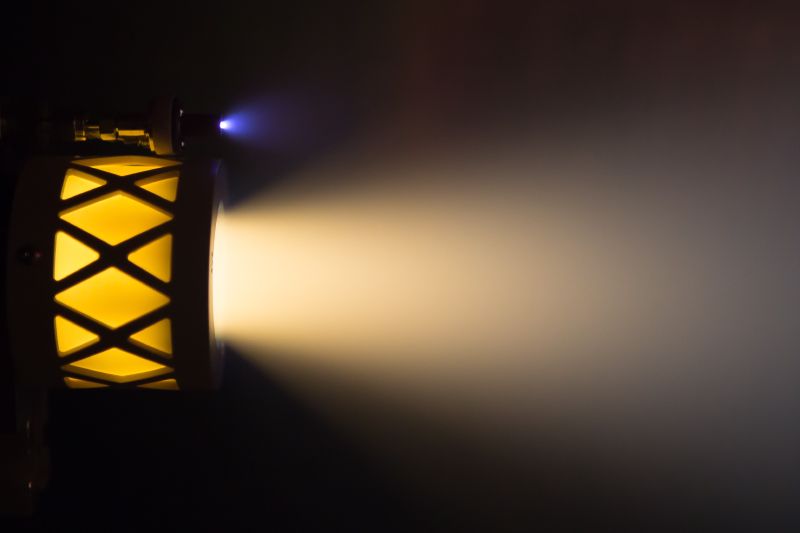
Xenon is a gas like helium or neon, only heavier. It flows into the engine, where it picks up an electrical charge, and charged atoms are called ions.
DLR describes one way to do this. Electrons are fired into a magnetic field containing the xenon. When one hits an atom, the atom loses an electron and becomes a positive ion.
Voltage then does the pushing. NASA says a pair of grids, charged to almost 1,300 volts, flings the ions out of the engine at great speed. The ions race away, and the spacecraft moves the other way.
The engine works on the same principle as a chemical rocket. NASA compares it to a balloon that rushes around as air escapes. What differs is how efficiently the exhaust leaves.
Why the push is so small
NASA puts the speed of the xenon ions at about 40 kilometres a second, roughly ten times faster than the exhaust of a conventional rocket. That means an ion engine needs only a tenth as much propellant.
The UK Space Agency gives a higher figure for electric propulsion in general, at around 100 kilometres a second.
The thrust stays low because the engine uses very little xenon at once. It can take four days or more to use up one kilogram. The European Space Agency (ESA) says the thrusters on its GOCE satellite throttle between 1 and 20 millinewtons. A few millinewtons equal the weight of a few drops of water on Earth.
What a gentle push achieves
An ion engine makes up for low thrust by running for a very long time. Chemical engines fire for minutes, or an hour at the extreme. Ion engines can run for years.
NASA’s Deep Space 1 shows the effect. It used less than 74 kilograms of xenon. That bought a speed gain of about 4.3 kilometres a second, more than any spacecraft had managed. The engine thrusted for 678 days.
DLR gives figures for Dawn. Its engines need only 250 grams of xenon to fire for 24 hours. Over the whole mission they were due to run for 50,000 hours and use 425 kilograms of xenon.
DLR also says each kilogram of that fuel produces ten times the thrust of a kilogram of hydrogen and oxygen in a conventional rocket.
Where else the push is useful
ESA’s GOCE satellite orbits at about 280 kilometres. A few wisps of atmosphere still create drag there, and its thruster is set automatically to cancel that drag, so the satellite stays in freefall.
Power is the limit for longer trips. The UK Space Agency says electric propulsion needs a lot of it, and it funded a project to pair nuclear power with electric thrusters. The University of Southampton led the work, which tested a Hall thruster the agency says is potentially the largest in Europe.
The agency says such a system could make a two-year return trip to Mars possible.