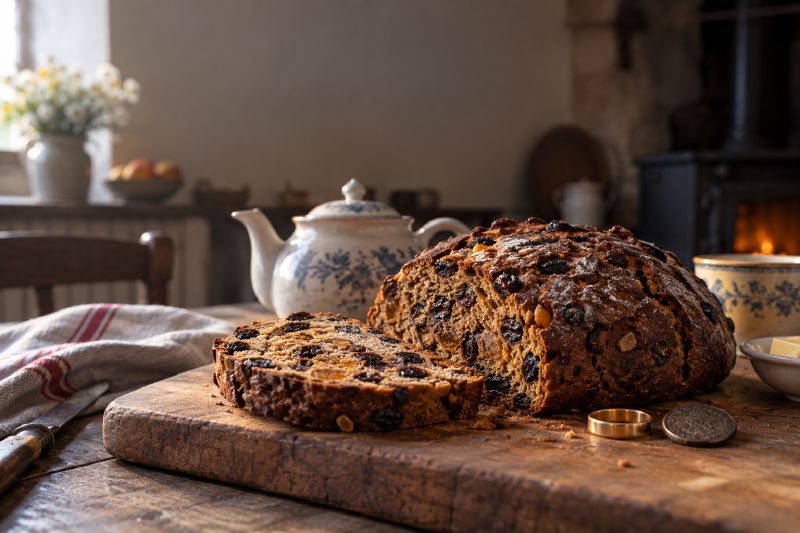
Barmbrack is an Irish fruit bread that doubles as a fortune teller. Small objects hide inside the loaf, and each one is an omen for the person who finds it.
Saveur lists four charms: cloth, a coin, a dried bean and a ring. Parchment wraps each one. The cloth points to lean times and the coin to wealth. The bean means spinsterhood, and the ring means marriage.
What the charms mean
The Guardian’s Felicity Cloake gives a slightly different list. In her account, the ring means marriage within the year and the pea means the opposite. A stick foretells a dispute, and a silver coin brings good fortune. She writes that a piece of cloth is a sign to hide under the duvet.
Saveur’s author recalls finding a tin ring in a slice at a boyfriend’s home in Cork. His family teased her that it meant marriage, and she later married him.
James Joyce put the custom into fiction. His short story Clay describes the fortune-telling, according to the Guardian.
Why Halloween
The sources do not say who first baked a ring into a loaf. They do give a root for the season. Saveur ties barmbrack to Samhain, the ancient Celtic harvest celebration. The Guardian adds that the loaf was once kept for high days and holidays, Halloween above all.
That Halloween link has loosened. Irish bakers stock their shelves with barmbrack every autumn. The Guardian found one local bakery selling it from mid-February, ahead of St Patrick’s Day.
What is in the loaf
The name comes from the Irish báirín breac, which means speckled bread. The Guardian says it resembles the Welsh bara brith, a plain bread rich with fruit that suits butter and a pot of tea.
Most modern recipes raise the loaf with baking powder. Older ones used yeast, and “barm” itself is the foam that gathers on a fermenting drink such as beer.
Tea explains the other name, tea brack. Cloake notes that the three recipes she tried without yeast all soak the fruit in black tea overnight.