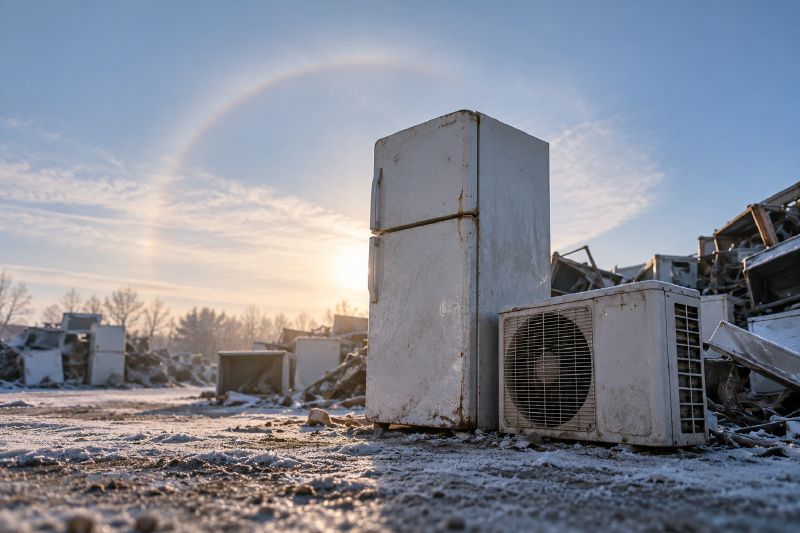
Air conditioning harms the climate in two separate ways. Mark Radka, who heads the energy and climate branch of the UN Environment Programme, calls cooling a double burden. Much of today’s equipment runs on refrigerants that are potent greenhouse gases, and it also uses a lot of energy. Neither cost is fixed. Both depend on which gas sits inside the machine and how the grid that powers it is fed.
The harder part is that the same machine keeps people alive in heat.

more
How big is the climate cost?
Radka puts refrigeration and air conditioning at 7% of global greenhouse gas emissions today. On a business-as-usual path, he expects that share to double by 2030 and triple by 2050, even with the cuts to hydrofluorocarbons the Kigali Amendment to the Montreal Protocol requires.
Space cooling already takes nearly 20% of the electricity used in buildings, according to UNEP. It is the fastest-growing use of energy in buildings worldwide, and Radka expects it to triple by 2050.
The machines are multiplying too. The International Energy Agency projects that the number of units worldwide could rise by 244% by 2050, the Guardian reported. For the US alone, a 2020 analysis by the research group Climate Central put the likely growth in demand at 59%. Most of the world’s energy still comes from fossil fuels, which is what turns that extra demand into extra emissions.
The gas inside is the part people miss
Most units cool by cycling a refrigerant, and the commonest are hydrofluorocarbons, or HFCs. The Guardian describes them as thousands of times better at trapping heat than carbon dioxide.
Car air conditioning shows how the chemistry has moved. The US EPA says new vehicles stopped using CFC-12, an ozone-depleting refrigerant, in the mid-1990s. Its replacement, HFC-134a, spares the ozone layer but warms the planet 1,430 times as much as carbon dioxide. The EPA estimates car systems account for about 24% of all HFC consumption worldwide. Carmakers began moving to lower-warming gases such as HFO-1234yf in 2012.
Home units face the same trade-offs. R-32, now widely fitted, is still an HFC, though the Guardian says it warms the planet about half as much as the older ones. Hydrofluoroolefins go further but can still harm ecosystems. Ammonia and propane avoid the greenhouse problem and bring another, since both can hurt people when they leak.
Why “use less” is not the whole answer
Heat kills. In the US, extreme heat is the deadliest kind of extreme weather, the Guardian reports. One study it cites modelled a five-day heatwave striking Phoenix during a power cut. More than half the city’s 1.4 million people could end up in the emergency room.
Access is uneven. A 2019 study co-written by Narasimha Rao, a professor of energy systems at Yale, found between 1.8 and 4.1 billion people in developing countries face dangerous heat without cooling.
Europe shows how fast need can change. Carbon Brief puts household use at about 6% in Germany and 4% in England, against more than 90% in the US. Its analysis found that many European cities rarely saw days above 30C before the 2020s. Jan Rosenow, an energy researcher at the University of Oxford, told Carbon Brief that British and German homes were designed to hold warmth in, because summers there were rarely hot. Nearly 60% of Italian households already have it, according to government figures.
What shrinks the footprint
Efficiency is a large gap. The IEA found that in 2018 the average unit was less than half as efficient as the best on sale, the Guardian reported. The least efficient models, often in poorer homes, cost more to run and warm the planet more.
Les Norford, professor of building technology at MIT, told the Guardian that cooling air and drying it in one process makes the machines “terribly inefficient”. He and others are working to split the two jobs, using desiccants or living membranes to pull out moisture.
Rao points to fans, which are far cheaper to run and can give up to 2C of relief in hot, dry places.
Cities can lower the demand before anyone switches a unit on. UNEP says a single tree on a sunny day can transpire several hundred litres of water. That cools about as much as two home air conditioners running for 24 hours. It cites research finding that $100 million a year spent on street trees would cut peak temperatures by 1C for 77 million people on hot days.
The open question is which arrives first: the efficient machines and cleaner gases, or the billions of new buyers who need them.